Category: AI Services

  • AI Agent for Ecommerce: How Shopify Clothing Stores Can Automate Customer Support

    AI Agent for Ecommerce: How Shopify Clothing Stores Can Automate Customer Support

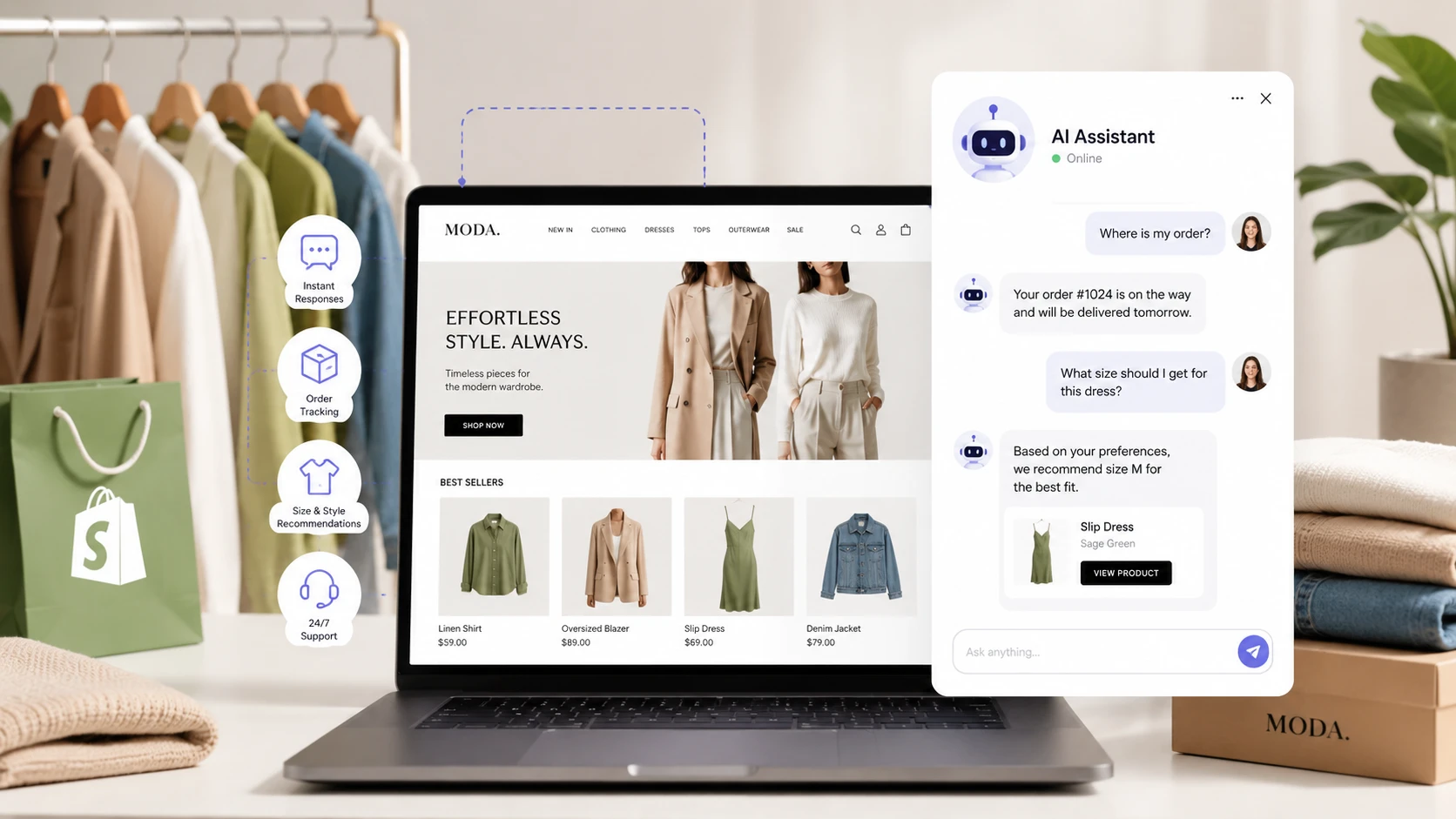
    Quick Answer: An AI agent for ecommerce is an autonomous system that can answer customer questions, recommend products, support returns, check order details, and guide shoppers through buying decisions without constant human oversight. For Shopify clothing stores, the real value is not just “having a chatbot,” but building a smarter customer support and sales layer that works across the full shopping journey.

    Picture this: it is 2 AM, and someone in Tokyo is searching your store for the perfect birthday gift. At the same time, a customer in Berlin needs help processing a return, while someone in Chicago cannot decide between two product variants. Five years ago, you would need a global support team working around the clock. Today, a properly configured AI agent for ecommerce can handle all three conversations at once — and in many cases, do it faster than a tired support team after their fourth coffee.

    The shift happening right now is not just about chatbots getting smarter. We are watching ecommerce support move from simple “helpful assistant” tools into systems that can actually run meaningful parts of the customer experience: answering questions, qualifying needs, recommending products, reducing abandoned carts, and escalating complex cases to humans only when needed.

    For Shopify clothing stores, this matters even more. Fashion ecommerce has a lot of repetitive but important questions: sizing, fabric, shipping, returns, outfit matching, product availability, and “which one should I choose?” If those questions are not answered quickly, shoppers leave.

    That is where AI agents become useful.

    If you are building a more advanced ecommerce operation, this type of automation can also connect naturally with broader AI services, store automation, and custom software development workflows.

    What Is an AI Agent for Ecommerce?

    Let’s cut through the marketing noise for a second.

    An AI agent for ecommerce is not just a pop-up chat window that says “How can I help you today?” and then fails to understand a simple question. A real AI agent can use store data, product information, customer context, order status, and business rules to take useful actions or guide a customer toward the next best step.

    Traditional ecommerce chatbots usually follow fixed scripts. They wait for a trigger, match a keyword, and return a pre-written answer. That can be useful, but it is limited.

    AI agents are different because they can understand context, remember the conversation, make decisions within rules, and adapt their response based on what the customer is actually trying to do.

    Think of the difference like this:

    Traditional automation is a vending machine. Press B4, get chips.

    An AI agent is closer to a trained store employee who remembers customer preferences, notices that someone is browsing winter coats in July, understands that they might be planning a trip, and adjusts the recommendation accordingly.

    Why Shopify Clothing Stores Are a Strong Use Case

    Shopify clothing stores are one of the clearest use cases for ecommerce AI agents because customers usually need help before they buy.

    A shopper might like a product but still hesitate because of size, fit, delivery time, return rules, or uncertainty about whether the item matches something they already own. These small doubts often become abandoned carts.

    The problem is not always product quality. Sometimes the problem is silence.

    A customer asks a question. Nobody answers quickly. They leave.

    An AI agent can reduce that gap by giving immediate, useful guidance at the moment the shopper is still interested.

    For clothing stores, this can include:

    • Size and fit guidance: Helping shoppers choose the right size based on product notes, previous purchases, or store rules.
    • Product recommendations: Suggesting similar items, matching accessories, or better alternatives when something is out of stock.
    • Return and exchange support: Explaining return rules, starting return flows, or guiding customers to the correct next step.
    • Order tracking: Checking order status and giving customers direct updates instead of sending them to a generic help page.
    • Cart recovery support: Answering last-minute doubts before the customer abandons checkout.

    This is why an AI agent for ecommerce is not just a support tool. It can become part of the sales system.

    The Core Capabilities of a Real AI Agent for Ecommerce

    Not every chatbot should be called an AI agent. The label only makes sense when the system can do more than respond with canned answers.

    A useful ecommerce AI agent usually has four core capabilities.

    1. Autonomous Decision-Making

    The agent should not need a human to approve every basic action. It should be able to answer common questions, suggest products, provide policy information, and guide routine processes on its own.

    That does not mean it should have unlimited control. It still needs boundaries. For example, it may be allowed to explain a return process, but not approve unusual refunds without human review.

    Good automation gives the agent enough freedom to be useful without letting it create business risk.

    2. Contextual Understanding

    A real AI agent should understand the customer’s situation, not just the words in one message.

    If someone asks, “Will this fit me?” while viewing a specific jacket, the agent should know which product they are looking at. If someone asks, “Can I return it?” after checking the size guide, the agent should understand the concern is probably about fit risk.

    This context is what makes the experience feel useful rather than robotic.

    3. Multi-Channel Continuity

    Customers do not always stay in one channel. They may start on live chat, continue through email, then come back later from a phone or desktop browser.

    A stronger AI agent setup can maintain context across channels, or at least make sure the handoff does not feel broken.

    That matters because customers hate repeating themselves. If they already explained the problem once, the system should not treat them like a stranger every time.

    4. Goal-Oriented Behavior

    A normal chatbot is designed to “reply.” An AI agent should be designed to achieve outcomes.

    In ecommerce, those outcomes might include:

    • Answering a question clearly.
    • Helping the customer choose the right product.
    • Reducing return risk.
    • Recovering an abandoned cart.
    • Escalating complex problems to a human quickly.

    The goal is not to automate for the sake of automation. The goal is to make the customer journey easier and the store operation more efficient.

    How an AI Agent Works Inside an Ecommerce Store

    Let’s make this practical.

    When a customer lands on your Shopify store, a properly configured AI agent can start using context before the customer even asks a question. It may consider the page being viewed, product category, cart status, browsing behavior, and previous interactions if available.

    The agent does not need to interrupt every visitor. In fact, aggressive pop-ups usually hurt the experience. A better implementation waits for useful moments: hesitation, repeated product views, cart inactivity, or direct customer questions.

    The Customer Support Automation Layer

    This is where most businesses start, and for good reason.

    AI customer support for ecommerce can handle a large percentage of routine inquiries when the system is connected to the right data sources.

    For example, when someone asks, “Where is my order?” the agent should not simply send a generic tracking page. It should check the customer’s order, identify the shipping status, and provide a clear answer.

    When someone asks about returns, the agent should explain the policy, guide the customer through the process, and hand off to a human if the case is unusual.

    This layer can reduce pressure on support teams while improving response speed for customers.

    The Product Discovery and Sales Layer

    Support is only one part of the value.

    An ecommerce AI agent can also help shoppers discover the right products. This is especially useful in clothing, accessories, beauty, electronics, and any category where customers compare options before buying.

    Instead of showing generic recommendations, the agent can ask a few simple questions and narrow the options:

    • What occasion are you buying for?
    • Do you prefer a loose or fitted style?
    • What size do you usually wear?
    • Are you looking for something casual, formal, or seasonal?

    This feels closer to assisted shopping than standard ecommerce filtering.

    For stores that want to go further, AI can also connect with tools like virtual try-on, product matching, and personalized shopping flows. This is where AI virtual try-on software becomes relevant for clothing brands that want a more visual buying experience.

    The Retention and Post-Purchase Layer

    A strong AI agent does not stop after checkout.

    Post-purchase support is one of the biggest opportunities in ecommerce automation. The agent can help with tracking, delivery questions, return instructions, review requests, reorder reminders, and product care guidance.

    This is not always glamorous, but it has a direct impact on customer satisfaction.

    A shopper who gets quick help after buying is more likely to trust the store again.

    What AI Agents Can Automate in a Shopify Clothing Store

    For a Shopify clothing store, the most practical use cases are usually simple, repetitive, and high-volume.

    Here are the areas where an AI agent can make a visible difference.

    Product Questions

    Customers often ask about fabric, fit, measurements, colors, washing instructions, availability, or whether an item matches another product.

    If your product data is organized properly, the AI agent can answer these questions quickly without waiting for a human.

    This is one of the easiest areas to automate because the answers usually already exist somewhere in your product descriptions, size guides, policies, or internal notes.

    Size Guidance

    Sizing is one of the biggest friction points in fashion ecommerce.

    An AI agent can guide customers through size selection by asking structured questions and referencing your size chart. It can also explain whether an item runs small, large, fitted, oversized, or true to size if that information exists in your store data.

    This does not eliminate returns completely, but it can reduce avoidable mistakes.

    Order Tracking

    Customers asking “Where is my order?” are not trying to have a conversation. They want a fast answer.

    An AI agent connected to order and shipping data can provide that answer instantly. This saves time for both the customer and the support team.

    Returns and Exchanges

    Returns are repetitive, but they must be handled carefully.

    The agent can explain the return window, check eligibility, guide the customer through the steps, and collect the required information. For unusual cases, it can escalate to a human with the context already prepared.

    Abandoned Cart Recovery

    Sometimes a shopper abandons a cart because of a question that was never answered.

    An AI agent can help before that happens. If a customer is stuck on a product page or checkout step, the agent can offer specific help instead of generic discount pop-ups.

    For example:

    • “Need help choosing the right size?”
    • “Want to compare this with a similar item?”
    • “Looking for delivery information before checkout?”

    This is more useful than shouting “10% off” at every visitor.

    Common Myths About AI Agents for Ecommerce

    Let’s address a few myths that still create confusion.

    Myth 1: AI Agents Will Replace All Human Support Staff

    No. At least, not in a healthy setup.

    What usually happens is that the support team stops answering the same basic questions all day and starts handling the cases that actually need human judgment.

    The agent handles volume. Humans handle nuance.

    That means your best support people can focus on difficult customers, sensitive cases, high-value orders, and improving the customer experience instead of repeating “Here is our return policy” for the hundredth time.

    Myth 2: You Can Set It and Forget It

    Also no.

    An AI agent for ecommerce needs training, monitoring, and refinement. It is closer to having a smart assistant that learns quickly but still needs guidance on your policies, tone, product logic, and escalation rules.

    You will still need to review edge cases, improve product data, update policies, and adjust the agent’s behavior based on real conversations.

    It is less work than scaling a large support team, but it is not zero work.

    Myth 3: Only Big Brands Can Afford This

    This used to be more true than it is now.

    Small and mid-sized ecommerce stores are often strong candidates because they feel the pain of support volume earlier. They may not have the budget for a large customer service team, but they still need fast answers and consistent support.

    The key is choosing the right implementation level. Not every store needs a complex custom agent on day one.

    The Right Way to Implement an AI Agent

    The safest approach is not to automate everything at once.

    Smart stores start with one controlled use case, prove value, and then expand.

    Phase 1: After-Hours Support

    A simple first step is to deploy the AI agent outside business hours.

    Your human team continues handling normal daytime support, while the agent covers nights, weekends, and time zones your team cannot reach easily.

    This gives you a lower-risk way to test quality, train the system, and discover common gaps.

    Phase 2: Tier-1 Questions During Business Hours

    Once the agent performs well, it can start handling simple questions during normal hours too.

    These might include:

    • Order tracking.
    • Return policy questions.
    • Basic product information.
    • Size guide explanations.
    • Shipping time questions.

    Humans should remain available for escalations.

    Phase 3: Sales Assistance and Personalization

    After support automation is stable, the next step is sales assistance.

    This is where the agent starts helping shoppers choose products, compare options, and receive better recommendations.

    At this stage, the agent becomes part of the revenue system, not just the support system.

    Integration Requirements You Should Check First

    Before choosing any AI agent platform, check whether it can actually connect to the systems your store already uses.

    This is where many ecommerce AI projects succeed or fail.

    A nice demo is not enough. The agent needs reliable access to the right data, and it needs clear rules for what it can and cannot do.

    Essential Integrations

    At minimum, an AI agent for ecommerce usually needs access to:

    • Your ecommerce platform: Shopify, WooCommerce, or a custom store backend.
    • Product catalog: Product titles, descriptions, variants, images, stock status, and pricing.
    • Order data: Order status, customer details, payment status, and fulfillment updates.
    • Shipping tools: Tracking numbers, carrier updates, delivery estimates, and failed delivery notes.
    • Store policies: Returns, refunds, shipping rules, exchanges, warranty, and support terms.

    Without these connections, the agent becomes a smarter FAQ tool. With them, it becomes a real operational assistant.

    Advanced Integrations

    More advanced stores may also connect the agent to:

    • CRM systems.
    • Email marketing tools.
    • Loyalty programs.
    • Inventory management systems.
    • Analytics platforms.
    • ERP or custom internal systems.

    This is where custom software development may become necessary, especially if your store uses custom workflows that standard apps cannot handle cleanly.

    How to Choose the Right AI Agent for Ecommerce

    The market is full of tools calling themselves AI agents, AI chatbots, AI assistants, or customer support automation platforms. The names are less important than what the system can actually do.

    Here are the criteria that matter.

    1. Can It Take Real Actions?

    There is a big difference between a tool that says, “You can return your item from the returns page,” and a tool that can actually start the return process.

    The more actions the agent can safely perform, the more valuable it becomes.

    Useful actions might include:

    • Checking order status.
    • Starting a return request.
    • Recommending available products.
    • Collecting customer details before escalation.
    • Creating a support ticket.
    • Sending a product or policy link.

    Start with safe actions first, then expand gradually.

    2. How Does It Learn Your Store?

    Some AI tools require heavy manual setup. Others can learn from your product catalog, help center, policy pages, previous support conversations, and internal documents.

    Both approaches can work, but you need to know what is required before you start.

    For a clothing store, the agent should understand:

    • Product categories.
    • Size guides.
    • Fabric and material details.
    • Shipping rules.
    • Return policy details.
    • Brand tone and style.

    Poor training creates vague answers. Good training creates a useful assistant.

    3. Does It Escalate Properly?

    Escalation is one of the most important parts of ecommerce AI support.

    A bad AI agent keeps guessing when it should stop. A good AI agent knows when to bring in a human.

    Escalation should happen when:

    • The customer is angry or frustrated.
    • The case involves payment problems.
    • The agent is not confident.
    • The request is outside the store’s policy.
    • The customer asks for a human.
    • The order value or risk level is high.

    The handoff should include the conversation history so the human support agent does not need to ask the customer to repeat everything.

    4. Can You Control the Brand Voice?

    Your AI agent should not sound like a generic corporate robot.

    If your brand is playful, the agent should feel friendly and light. If your brand is premium, it should feel polished and calm. If your audience is technical, it can be more direct and detailed.

    Brand voice matters because the AI agent becomes part of the customer experience. Customers may not analyze the tone consciously, but they will feel when something is off.

    Risks and Limitations You Should Not Ignore

    AI agents can be powerful, but they are not magic. There are real risks, and pretending they do not exist is how bad implementations happen.

    Incorrect Answers

    AI systems can sometimes generate confident answers that are wrong. In ecommerce, that can mean incorrect product details, wrong delivery expectations, or policy confusion.

    The solution is to ground the agent in verified store data, restrict risky actions, and create clear escalation rules.

    Weak Product Data

    If your product data is messy, the AI agent will struggle.

    For example, if size charts are inconsistent, product descriptions are thin, and return rules are unclear, the agent has weak material to work with.

    Before blaming the AI, check the data.

    Over-Automation

    Not every customer interaction should be automated.

    Some situations need empathy, negotiation, or human judgment. If the agent blocks customers from reaching a human, it can damage trust quickly.

    The goal is not to hide your support team. The goal is to let the AI handle repetitive work while humans handle the cases that deserve human attention.

    Privacy and Compliance

    An ecommerce AI agent may process customer names, order information, messages, browsing behavior, and purchase history.

    That means privacy matters.

    You need to understand how the platform stores data, whether it uses customer conversations for training, what security controls exist, and whether it supports relevant privacy requirements in your market.

    For broader context on ecommerce AI use cases, Shopify’s guide to AI in ecommerce is a useful industry reference.

    How to Measure Success

    Do not judge an AI agent only by how many messages it sends. That number alone does not mean much.

    Measure whether it improves the business.

    Support Metrics

    Start with operational metrics:

    • Response time: How quickly customers get a useful answer.
    • Resolution rate: How many conversations are solved without human intervention.
    • Escalation rate: How often the agent needs a human.
    • Customer satisfaction: Whether customers are happy with the answer.
    • Support workload: Whether repetitive tickets decrease.

    These metrics tell you if the agent is actually helping your support process.

    Sales Metrics

    For ecommerce, support is only part of the picture.

    You should also look at:

    • Conversion rate.
    • Cart abandonment rate.
    • Average order value.
    • Repeat purchase rate.
    • Revenue from assisted sessions.

    A good AI agent can improve sales by answering objections at the right moment, helping customers choose, and making the buying process feel easier.

    When an AI Agent Is Worth It — and When It Is Not

    An AI agent for ecommerce is not necessary for every store.

    It is usually worth exploring if:

    • You receive repeated customer questions every week.
    • Your team spends too much time answering basic support tickets.
    • You sell products that require explanation or comparison.
    • Your store serves customers in different time zones.
    • You lose sales because shoppers do not get quick answers.
    • You are scaling and support costs are growing with revenue.

    You may want to wait if:

    • Your store has very little traffic.
    • Your product data is incomplete or messy.
    • Your policies change constantly.
    • You do not have anyone who can monitor and improve the system.

    The technology is no longer experimental, but it still needs a responsible setup.

    Final Thoughts

    An AI agent for ecommerce is not just a trend or a fancy chatbot. When implemented properly, it becomes a practical layer between your customers, products, policies, and support team.

    For Shopify clothing stores, the opportunity is clear. Customers need help with size, fit, availability, shipping, returns, and product choices. If those questions are answered quickly and naturally, the store has a better chance of converting visitors into buyers.

    The right approach is not to automate everything overnight. Start with the repetitive support questions. Connect the agent to reliable store data. Set clear escalation rules. Then expand into product recommendations, cart recovery, and post-purchase automation.

    Done well, an AI agent does not replace the human side of ecommerce. It protects it by removing repetitive work and giving people more time for the conversations that actually need them.

    If you want to build a more advanced customer support or ecommerce automation system, JustOnePrompt can help connect AI agents with Shopify workflows, store data, and custom automation logic through AI services and store automation.

    Frequently Asked Questions

    What is an AI agent for ecommerce?

    An AI agent for ecommerce is an autonomous system that helps customers across the buying journey. It can answer questions, recommend products, support returns, check order information, and escalate complex issues to humans when needed.

    How is an AI agent different from a normal ecommerce chatbot?

    A normal chatbot usually follows fixed scripts or simple keyword rules. An AI agent can understand context, use store data, make decisions within defined rules, and guide customers toward useful outcomes.

    Do Shopify clothing stores really need an AI agent?

    Not every store needs one immediately, but Shopify clothing stores with repeated questions about sizing, returns, shipping, product recommendations, or order tracking can benefit from an AI agent because it reduces response time and helps customers make buying decisions.

    Can an AI agent increase ecommerce sales?

    Yes, when implemented well. An AI agent can increase sales by answering product questions quickly, reducing abandoned carts, recommending relevant products, and helping customers feel more confident before checkout.

    Will an AI agent replace human support?

    Usually no. The best setup uses AI agents for repetitive questions and routine workflows, while human support handles complex, emotional, sensitive, or high-value cases.

    How long does it take to implement an AI agent in a Shopify store?

    A basic implementation can take a few days if the store uses standard Shopify apps and clear policies. A more advanced setup with custom workflows, integrations, and brand-specific training may take several weeks.

    What should I prepare before using an ecommerce AI agent?

    You should prepare clear product data, size guides, return policies, shipping rules, support FAQs, escalation rules, and examples of your brand voice. The better your data, the better the AI agent will perform.

  • Generative AI in E Commerce: How Clothing Brands Use It to Scale Faster

    Generative AI in E-Commerce: How Clothing Brands Use It to Scale Faster

    Quick Answer: Generative AI in e-commerce helps clothing brands create product descriptions, campaign content, personalized shopping experiences, virtual try-on previews, styling assistance, and customer support at scale. The goal is not to replace the creative team, but to help the brand launch collections faster, reduce repetitive work, and give shoppers more confidence before they buy.

    Picture this: You’re scrolling through a clothing store at 2 a.m. (no judgment, we’ve all been there), looking at a jacket that seems almost perfect. The product page explains how it fits, suggests trousers that actually match, answers your oddly specific question about whether the fabric works in warm weather, and lets you preview the look before buying.

    That’s not magic. That’s generative AI in e-commerce doing its thing.

    For clothing brands, the pressure is especially intense. New collections arrive constantly, product catalogs grow fast, trends change without warning, and every item needs photos, descriptions, campaigns, translations, sizing information, emails, social posts, and customer support.

    What used to require weeks of coordination can now be handled faster with AI-assisted workflows. Not fully automated, not blindly published, and definitely not without human review—but faster, more consistently, and at a scale that would exhaust even the most caffeinated marketing team.

    What Is Generative AI in E-Commerce?

    Generative AI refers to artificial intelligence systems that create new content—text, images, conversations, product summaries, campaign ideas, and other outputs—rather than only analyzing existing data.

    In fashion e-commerce, this might mean:

    • Writing product descriptions from verified catalog data
    • Creating variations of email and advertising copy
    • Generating localized content for different markets
    • Powering conversational shopping and styling assistants
    • Producing visual previews and virtual try-on experiences
    • Summarizing reviews about sizing, fabric, or fit

    Think of it as the difference between a vending machine and a personal stylist. Traditional automation follows predefined rules. Generative AI can use context—such as product details, brand voice, customer questions, and shopping intent—to create a more relevant response.

    That doesn’t mean the AI magically understands fashion. It still needs accurate product data, clear instructions, and human oversight. But when those pieces are in place, it becomes a seriously useful assistant.

    The Building Blocks Behind Fashion AI

    Most generative AI applications rely on large language models, image-generation systems, or multimodal models that can work with both text and visuals.

    For a clothing brand, the quality of the output depends heavily on the information provided to the system:

    • Product data: fabric, cut, size range, color, care instructions, and availability
    • Brand guidelines: tone, vocabulary, positioning, and words the brand avoids
    • Visual assets: approved product images, model photography, and campaign references
    • Customer context: browsing behavior, previous purchases, questions, and preferences where appropriate
    • Business rules: return policies, shipping information, promotions, and regional restrictions

    Here’s what makes generative AI different from earlier ecommerce automation:

    • Creation vs. prediction: It can produce a new description, answer, image, or campaign variation
    • Context awareness: It can adapt the output to a product category, customer question, or brand tone
    • Scalability: The same workflow can assist with ten products or ten thousand
    • Multichannel use: One approved source can support product pages, emails, ads, social media, and customer service

    Why Clothing Brands Use Generative AI in E-Commerce to Scale Faster

    Let’s pause for a second and talk about the elephant in the virtual fitting room: why should a clothing brand care about this particular technology when a new “game-changing” AI tool appears every other week?

    The answer isn’t simply “because AI is popular.”

    Clothing brands face a combination of problems that generative AI is unusually well suited to help with: large product catalogs, fast collection cycles, visual buying decisions, sizing uncertainty, content bottlenecks, international markets, and repetitive customer questions.

    Shopify’s current overview of generative AI use cases in ecommerce highlights applications across product content, marketing channels, customer support, and operational analysis. For fashion stores, those areas are closely connected.

    A new clothing collection doesn’t just need products. It needs a complete content system around those products.

    Content Production Without the Burnout

    I once heard an ecommerce manager describe launching a new collection as “copying the same chaos into a different spreadsheet.” Honestly, that feels accurate.

    Every new item may require:

    • A detailed product description
    • A shorter mobile-friendly summary
    • Fabric and care information
    • SEO title and meta description
    • Email campaign copy
    • Social media captions
    • Ad variations
    • Translations for different markets

    Multiply that by hundreds or thousands of SKUs, and suddenly the creative team isn’t being creative anymore. They’re moving text from one box to another while quietly questioning every career decision they’ve ever made.

    Generative AI can produce first drafts and channel-specific variations from approved product information. The team still reviews the output, but it no longer has to begin every description with a blank page.

    Personalization at a Scale Humans Cannot Manually Manage

    Every retailer wants shoppers to feel understood. The problem is that manually personalizing the experience for thousands of visitors is impossible.

    Generative AI can help adapt the shopping journey by:

    • Emphasizing comfort, sustainability, versatility, or styling depending on customer intent
    • Creating personalized email copy around relevant product categories
    • Answering questions about styling combinations
    • Suggesting alternatives when a size or color is unavailable
    • Explaining why a recommended product may suit the shopper’s needs

    The important word here is relevant, not creepy.

    Personalization should help the shopper make a decision. It should not feel like the store has been watching through the window since Tuesday.

    Faster Expansion Into New Markets

    International fashion ecommerce involves more than translating “summer dress” into another language.

    Different markets use different sizing terms, seasonal language, styling references, cultural expectations, and purchasing habits. A direct translation can be technically correct and still sound like it was written by a very confused instruction manual.

    Generative AI can help clothing brands create localized versions of:

    • Product pages
    • Category introductions
    • Advertising campaigns
    • Email flows
    • Customer service responses
    • Size and care explanations

    Human reviewers who understand the target market are still essential, but AI can dramatically reduce the time needed to prepare the first version.

    Practical Generative AI Use Cases for Clothing Brands

    The most useful applications aren’t the ones that look impressive during a presentation. They’re the ones that solve a repetitive problem every single week.

    1. Product Description Generation

    This is usually the easiest place to start.

    A brand can connect verified catalog data to an AI workflow that produces descriptions using a consistent structure and tone.

    For example, the system might receive:

    • Product name
    • Material and fabric composition
    • Fit and silhouette
    • Available sizes and colors
    • Care instructions
    • Approved selling points

    It can then create:

    • A full product description
    • A short summary
    • Key feature bullets
    • SEO metadata
    • Email and social media variations

    The AI must never invent details that aren’t in the catalog. If the fabric isn’t wrinkle-resistant, the system shouldn’t confidently announce that it survives being folded inside a suitcase for three weeks.

    A good workflow uses structured product data, clear prompts, and an approval step before publishing.

    2. Campaign Content for New Collections

    Fashion campaigns need a lot of variations.

    The launch concept may stay the same, but the copy changes across:

    • Homepage banners
    • Collection pages
    • Email subject lines
    • Paid advertisements
    • Instagram captions
    • Short-form video scripts
    • Influencer briefing documents

    Generative AI can take an approved campaign direction and turn it into channel-specific drafts without losing the main message.

    This doesn’t replace the creative director. It helps the creative director avoid spending Thursday afternoon rewriting the same sentence in twelve slightly different ways.

    3. AI Virtual Try-On and Product Visualization

    One of the biggest challenges in fashion ecommerce is simple: customers cannot physically try the product before buying.

    Generative and visual AI systems can help shoppers preview how clothing may look using uploaded photos, model variations, or interactive visual experiences.

    Google’s shopping tools, for example, have expanded virtual try-on features that allow shoppers to upload a photo and preview supported clothing items. This shows how quickly virtual visualization is moving from experimental technology toward a normal part of online shopping.

    You can review Google’s explanation of its AI-powered virtual try-on shopping experience for a practical example.

    For clothing brands, virtual try-on can:

    • Make product pages more interactive
    • Help shoppers visualize complete outfits
    • Reduce hesitation before adding an item to the cart
    • Differentiate the store from competitors using static product images
    • Connect the visual preview directly with the purchase journey

    The result is still a visual approximation, not a guaranteed prediction of physical fit. That distinction should always be clear to the customer.

    JustOnePrompt also develops AI virtual try-on software for fashion stores that can be planned as a Shopify app, WooCommerce plugin, or independent SaaS product.

    4. Size and Fit Guidance

    Sizing questions create friction, returns, support tickets, and abandoned purchases.

    AI can organize and summarize information from:

    • Size charts
    • Product measurements
    • Verified customer reviews
    • Return reasons
    • Fit notes from the merchandising team

    Amazon Fashion has described using AI and large language models to improve size charts, summarize relevant fit feedback, and provide personalized fit insights.

    Its overview of AI-powered fashion fit features demonstrates how language models can make complicated sizing information easier for customers to understand.

    A clothing brand could use a similar principle to answer questions such as:

    • Does this item run small or large?
    • Is the fabric stretchy?
    • How does the fit compare with another product?
    • Which measurement should the customer prioritize?

    The system should explain available information clearly. It should not pretend it can guarantee fit when the underlying data does not support that promise.

    5. Conversational Styling Assistants

    Remember those old chatbots that responded to every question with “Please select one of the following options”?

    Yeah. Nobody misses them.

    A generative AI shopping assistant can have a more natural conversation with the customer. It can ask what type of event they’re shopping for, understand color or style preferences, recommend matching items, and suggest alternatives when something is unavailable.

    A useful styling assistant might help with questions such as:

    • What jacket works with these trousers?
    • Can you build a complete outfit for a casual wedding?
    • Which colors match this dress?
    • Do you have a similar item with longer sleeves?
    • What can I wear with these shoes?

    The system becomes even more useful when it is connected to live inventory. There’s no point recommending the perfect outfit if every item has been out of stock since last winter.

    6. Personalized Email and Post-Purchase Content

    Generative AI can create email variations based on customer behavior, product category, location, or purchase stage.

    Examples include:

    • Welcome emails adapted to the customer’s interests
    • Back-in-stock notifications with relevant alternatives
    • Abandoned-cart messages that reference the selected style naturally
    • Post-purchase care instructions
    • Cross-sell suggestions based on the purchased outfit
    • Review requests written in the brand’s tone

    This works especially well when AI content is connected with store automation. The workflow detects an event, checks the relevant data, creates or selects suitable content, and sends it through the correct channel.

    For the operational side, see how store automation services can connect orders, alerts, customer follow-up, email, WhatsApp, and internal tools.

    7. Smarter Upselling Without the Pushy Salesperson Energy

    Upselling in fashion should feel like styling help, not an ambush.

    Instead of showing random expensive products, generative AI can explain why an additional item complements what the shopper already selected.

    For example:

    • A belt that completes the dress
    • A jacket that matches the selected trousers
    • A second color of an item the customer already likes
    • A care product suitable for the fabric
    • A complete outfit built around the main purchase

    The recommendation engine may identify the products, while generative AI creates the explanation around them.

    For a deeper look at this use case, read how generative AI can support ecommerce upsells with smart automation.

    8. Review Summaries and Customer Insight

    Customers rarely want to read 400 reviews to discover whether a shirt runs small.

    Generative AI can summarize recurring themes from verified reviews, such as:

    • Fit and sizing
    • Fabric feel
    • Color accuracy
    • Comfort
    • Durability
    • Styling suggestions from buyers

    These summaries can help shoppers, but they can also help the brand.

    If hundreds of customers mention that a sleeve feels too short, that’s not just customer service information. That’s product development information waving both hands in the air.

    How Generative AI Helps Clothing Brands Scale Without Losing Their Voice

    Here’s the concern many brands have: if everyone uses the same AI tools, won’t every store start sounding exactly the same?

    Yes—if the implementation is lazy.

    Generic prompts produce generic content. If the instruction is simply “write a product description,” the output will probably contain phrases like “elevate your wardrobe” and “perfect for any occasion” until the internet collapses under the weight of its own adjectives.

    A better system includes:

    • Examples of approved brand copy
    • Clear tone and vocabulary rules
    • Words and claims the brand must avoid
    • Different formats for products, emails, ads, and support
    • Rules for fabric, sustainability, fit, and performance claims
    • A human approval process

    The goal is not to make AI sound human in a vague way. The goal is to make the output sound like the specific brand.

    Create One Reliable Source of Product Truth

    Before generating anything, organize the product information.

    If the product management system says one thing, the supplier spreadsheet says another, and the website contains a third version copied in 2022, AI will not fix the confusion. It will simply generate the confusion faster.

    Create a verified product source containing:

    • Official product names
    • Materials and percentages
    • Measurements
    • Size range
    • Care instructions
    • Available colors
    • Approved claims
    • Stock and regional availability

    Generative AI should create content from this source rather than guessing from incomplete information.

    Separate Generation From Publishing

    One of the safest implementation rules is simple: generating content and publishing content should be two different steps.

    A practical workflow might look like this:

    1. The product team enters or imports verified product data
    2. The AI generates the required content formats
    3. A team member reviews claims, tone, and accuracy
    4. The approved version is published to the store
    5. Performance and customer feedback are monitored

    Later, low-risk content may be approved automatically if the rules are reliable. But starting with full automatic publishing is how a brand ends up describing a polyester shirt as “handwoven from ethically sourced moonlight.”

    Common Myths About Generative AI in Fashion Ecommerce

    Myth #1: “It Will Replace the Creative Team”

    Generative AI is good at variations, first drafts, formatting, summarization, and repetitive content production.

    It is much less reliable at defining a distinctive brand identity, understanding cultural nuance without guidance, making strategic creative decisions, or recognizing when an idea is technically correct but emotionally terrible.

    The strongest setup is a creative team using AI as a production assistant—not an empty office with a chatbot wearing the creative director’s badge.

    Myth #2: “It Is Only for Large Fashion Retailers”

    Large retailers have more data and technical resources, but smaller clothing brands often have a clearer advantage: they can test one use case quickly.

    A small Shopify or WooCommerce store might begin with:

    • Product description drafts
    • Email variations
    • Customer question summaries
    • Simple styling assistance
    • A virtual try-on prototype for selected products

    The goal isn’t to build the entire future of fashion commerce by next Tuesday. It’s to solve one costly or repetitive problem, measure the result, and expand carefully.

    Myth #3: “AI Content Can Be Published Without Review”

    Absolutely not.

    Generative AI can invent details, misunderstand product information, exaggerate benefits, or create visuals that do not accurately represent the real item.

    Human review is especially important for:

    • Fabric and material claims
    • Sustainability statements
    • Size and fit guidance
    • Care instructions
    • Health or performance-related claims
    • Generated product imagery

    The technology is powerful. Powerful and unsupervised are not the same thing as useful.

    Risks Clothing Brands Need to Manage

    Inaccurate Product Information

    An attractive description is useless if the product details are wrong.

    AI-generated content must be grounded in verified catalog data. The system should not invent stretch, durability, fit, origin, or sustainability claims.

    Misleading Generated Images

    Generated fashion images can make a product appear different from reality. Colors, patterns, lengths, textures, and small design details may change during generation.

    Brands should clearly distinguish between:

    • Real product photography
    • AI-generated campaign imagery
    • Virtual try-on previews
    • Concept images that do not represent an exact product

    Transparency protects both the customer and the brand.

    Customer Privacy

    Virtual try-on, personalization, and conversational assistants may involve customer photos, preferences, or behavioral data.

    Brands should explain:

    • What information is collected
    • Why it is needed
    • How long it is stored
    • Whether it is shared with another provider
    • How the customer can delete or opt out

    “Trust us, the AI needs it” is not a privacy policy.

    Bias and Limited Representation

    Fashion systems should be tested across different body types, sizes, skin tones, ages, and styling preferences.

    A system trained or tested on a narrow set of examples may provide worse results for customers outside that set. Diverse testing is not an optional final step; it is part of building a usable product.

    A Practical 90-Day Implementation Plan

    You don’t need to rebuild the entire store. Start with one controlled use case.

    Days 1–30: Choose the Problem and Prepare the Data

    • Select one measurable problem
    • Choose a limited product category
    • Clean and verify product information
    • Document the brand voice
    • Define what the AI may and may not claim
    • Set a baseline for time, cost, conversion, or support volume

    A good first problem might be generating drafts for 100 product descriptions or handling common questions for one clothing category.

    Days 31–60: Build and Test the Workflow

    • Create prompt templates or automation steps
    • Generate content using approved data
    • Review accuracy and brand consistency
    • Test with internal users or a small customer segment
    • Record errors instead of pretending they didn’t happen

    This stage is about learning what fails.

    If every description contains the phrase “timeless elegance,” congratulations—you have discovered a prompt problem.

    Days 61–90: Measure and Expand Carefully

    Track metrics connected to the original problem:

    • Time required to prepare product content
    • Number of corrections before publishing
    • Customer engagement with the new experience
    • Conversion rate for tested product pages
    • Support questions about sizing or products
    • Return reasons
    • Use of virtual try-on or styling features

    Expand only after the workflow produces reliable results.

    Scaling a broken workflow doesn’t make it smarter. It just creates mistakes at enterprise speed.

    The Future of Generative AI in Clothing Ecommerce

    The direction is becoming clear: shopping experiences will become more conversational, visual, and adaptive.

    Customers will increasingly expect to:

    • Describe what they want in natural language
    • Build an outfit through conversation
    • Preview clothing on a personal image
    • Compare fit and style information quickly
    • Receive product explanations adapted to their priorities
    • Move from discovery to checkout without navigating endless menus

    The broader ecommerce market is already moving toward AI-assisted discovery, personalization, and automation. McKinsey’s 2026 analysis of how AI is reshaping ecommerce growth and competition reflects the wider shift taking place.

    But the winners won’t simply be the brands using the most AI.

    They’ll be the brands using it where it genuinely improves the customer experience, reduces unnecessary work, and supports a clear business strategy.

    Taking Action: Your Next Step

    Start by identifying the bottleneck that slows the brand down most.

    Is the team struggling to write product content? Are sizing questions overwhelming customer service? Does every collection launch require weeks of repetitive work? Are shoppers leaving because they cannot imagine how an item will look?

    Match the problem to one AI use case, test it on a limited scale, and keep humans responsible for accuracy and brand judgment.

    The competitive advantage won’t go to whoever installs the first AI tool they see.

    It will go to the clothing brands that connect generative AI with reliable product data, thoughtful automation, strong creative direction, and a shopping experience customers actually trust.

    Frequently Asked Questions

    What is generative AI in e-commerce for clothing brands?

    Generative AI in e-commerce helps clothing brands create product descriptions, campaign content, personalized responses, visual previews, styling assistance, and other shopping content from approved product and customer information.

    How can generative AI help a fashion brand scale faster?

    It can reduce repetitive content work, speed up collection launches, create channel-specific campaign variations, support localization, answer common customer questions, and assist with personalized shopping experiences.

    Can AI generate accurate clothing product descriptions?

    Yes, when the system uses verified product data and clear brand guidelines. Human review remains important because AI may invent or misunderstand details if the source information is incomplete.

    Can generative AI reduce fashion ecommerce returns?

    It may help reduce uncertainty through clearer sizing information, review summaries, fit guidance, and virtual try-on experiences. However, no AI system can guarantee fit or eliminate returns completely.

    Is AI virtual try-on accurate?

    AI virtual try-on provides a visual preview of how an item may look, but it should not be presented as a guaranteed representation of physical fit, fabric behavior, or exact color.

    Do small clothing stores need a custom AI system?

    Not always. A small store can begin with an existing tool or a limited automation workflow. Custom development becomes more useful when the brand needs unique integrations, control over data, a branded customer experience, or a scalable product for multiple stores.

    What is the safest first generative AI use case?

    Product description drafts are often a practical starting point because the workflow can use structured catalog data, remain behind a human approval step, and provide clear time-saving measurements.

  • SendPulse Review for Ecommerce Stores: Is It Worth It in 2026?

    SendPulse Review for Ecommerce Stores: Is It Worth It in 2026?

    This SendPulse review focuses especially on ecommerce stores that need practical automation without paying enterprise-level prices.

    Quick Answer: This SendPulse review reveals a budget-friendly, multi-channel marketing platform that combines email, SMS, and push notifications with solid automation tools—ideal for small to mid-sized businesses seeking an affordable alternative to pricier competitors like Klaviyo or ActiveCampaign.

    Why I’m Writing This SendPulse Review (And Why You Should Care)

    Let me tell you a story. A few months back, a friend who runs a small online boutique messaged me in full panic mode. Her email marketing tool had just tripled its pricing, and she was convinced she’d have to choose between paying rent or sending newsletters. Dramatic? Maybe. But when you’re bootstrapping a business, every dollar counts.

    That conversation sent me down a rabbit hole of marketing platforms, and SendPulse kept popping up like that friend who always shows up to parties uninvited but actually makes them better. So I dove deep into user reviews, tested features, and talked to people who’ve been using it daily. What I found surprised me—and might just save your budget too.

    This SendPulse review isn’t gonna be one of those sterile “10/10 would recommend” pieces. We’re looking at the real stuff: what works, what doesn’t, and whether it’s actually worth your time and money.

    If you’re comparing marketing tools because you want something smarter than basic email blasts, you may also want to look at how AI services and automation workflows can help connect your campaigns, customer data, and ecommerce operations into one cleaner system.

    What Exactly Is SendPulse? (The No-Jargon Version)

    SendPulse is a multi-channel marketing platform that lets you send emails, SMS messages, push notifications, and even chatbot messages—all from one dashboard. Think of it as the Swiss Army knife of digital communication, except it doesn’t cost as much as a premium espresso machine.

    The platform launched with email marketing as its main gig but has since expanded into pretty much every way you might wanna reach customers. Whether you’re running flash sales, sending abandoned cart reminders, or just trying to stay top-of-mind with your audience, SendPulse offers tools to make it happen.

    Who’s It Actually For?

    Based on real user feedback, SendPulse hits the sweet spot for:

    • Small to medium-sized businesses that need professional tools without enterprise-level price tags
    • Ecommerce stores looking to automate customer journeys across multiple channels
    • Budget-conscious marketing teams who refuse to compromise on essential features
    • Solo entrepreneurs who need something they can figure out without a PhD in marketing automation

    The Good Stuff: Where SendPulse Actually Shines

    It Won’t Murder Your Budget (Seriously)

    Let’s talk money, because that’s probably why you’re here. Multiple reviewers consistently mention SendPulse as one of the most affordable options in the marketing automation space. We’re talking about a platform that positions itself as significantly less expensive than competitors—some users mention saving compared to tools like ActiveCampaign and Klaviyo.

    The pricing structure includes pay-as-you-go options, which is perfect if your email sending patterns are more “sporadic creative bursts” than “consistent weekly schedule.” No shame in that game—most businesses don’t have perfectly predictable communication patterns.

    For more context on marketing automation pricing trends, check this external resource that breaks down industry standards.

    SendPulse Review: The User Experience Side

    Here’s where SendPulse really wins people over—it’s actually easy to use. Multiple reviewers describe the interface as simple and intuitive, which in software-speak means “you won’t need to watch seventeen YouTube tutorials just to send your first campaign.”

    The dashboard organizes your different communication channels in a way that makes sense. Email over here, SMS over there, automation flows in the middle. It’s not trying to be clever or revolutionary—it’s just organized in a way that respects your time and sanity.

    Plus, there’s a mobile app. Which means when you’re stuck in line at the grocery store wondering if your campaign went out, you can check without having to balance your laptop on a shopping cart. Not that I’ve tried that. Okay, maybe once.

    Features That Actually Matter for Ecommerce

    If you’re running an online store, SendPulse for ecommerce capabilities deserve special attention. The platform includes:

    • Abandoned cart automation that can recover sales while you sleep
    • Product recommendation engines that suggest items based on browsing behavior
    • Multi-channel workflows combining email, SMS, and push notifications for maximum reach
    • Segmentation tools that let you target specific customer groups with laser precision

    The automation capabilities are where SendPulse really flexes. According to user feedback, the automation features rival those of much pricier platforms. You can build complex customer journeys with conditional logic, trigger campaigns based on specific behaviors, and personalize content without needing a degree in computer science.

    For ecommerce teams that want to go beyond basic email sequences, this is where business automation becomes more interesting. The real win is not just sending messages automatically—it is connecting the store, customer behavior, follow-up messages, and reporting into one workflow that actually saves time.

    The Not-So-Great Stuff: Where SendPulse Stumbles

    Push Notification Reliability Gets Mixed Reviews

    Here’s the thing nobody wants to talk about at parties—some users report issues with push notification reliability. Specific complaints mention delays or complete delivery failures, which is… not ideal when you’re trying to announce a flash sale that ends in two hours.

    This creates an interesting contradiction because other reviewers describe the platform as “trustworthy” overall. My best guess? The push notification feature might be more temperamental than the rest of the platform, or perhaps it works better for some types of websites than others.

    Limited Head-to-Head Comparisons

    When researching this SendPulse review, I noticed something odd—there aren’t many detailed side-by-side comparisons with major competitors. The platform gets mentioned as an alternative to ActiveCampaign and Klaviyo, and there’s some comparison with OneSignal specifically for push notifications, but that’s about it.

    This makes it harder to know exactly where SendPulse ranks in specific feature categories. Is the email builder better than Mailchimp’s? How does the SMS pricing compare to Twilio? These questions don’t have easy answers in the current review landscape.

    If your ecommerce store needs more than a ready-made marketing platform can offer, you may eventually need custom software development to connect your store, CRM, marketing tools, payment systems, and reporting dashboards in a way that fits your actual business process.

    What Real Users Are Actually Saying

    The overall sentiment in reviews is predominantly positive, with people using words like “professional,” “trustworthy,” and “well-organized” to describe their experience. That’s corporate-speak for “it does what it says on the tin without making me want to throw my laptop out a window.”

    Users particularly appreciate the time-saving aspects. When you can manage email, SMS, and push notifications from one dashboard instead of juggling three different platforms, that’s hours back in your week. Hours you could spend on actually growing your business instead of wrestling with marketing tools.

    The Quality Question

    Multiple reviewers mention high product quality with minimal bugs or glitches. In the software world, that’s basically a standing ovation. Most platforms have that one annoying bug that everyone just learns to work around—like a quirky roommate you eventually get used to. SendPulse seems to have fewer of those personality quirks than average.

    The user reviews on G2 echo these sentiments across different business sizes and industries.

    SendPulse for Ecommerce: A Deeper Dive

    Let’s pause for a sec and talk specifically about using SendPulse for ecommerce, because that’s where this platform really shows its value proposition.

    Ecommerce businesses live and die by their ability to reach customers at the right moment with the right message. SendPulse’s multi-channel approach means you’re not putting all your eggs in the email basket—which is smart considering email open rates aren’t what they used to be.

    Building Customer Journeys That Actually Convert

    Here’s the simple version: SendPulse lets you create automated sequences that follow customers through their buying journey. Someone browses your site but doesn’t buy? Hit them with an email. Still nothing? Send a push notification. They add something to cart but don’t complete checkout? SMS reminder with a small discount.

    This layered approach increases your chances of making the sale without being annoying. The key is spacing out your messages appropriately—something the platform’s automation workflows help you do.

    • Welcome series for new subscribers that introduce your brand and top products
    • Browse abandonment flows that remind people about products they viewed
    • Post-purchase sequences that encourage reviews and repeat purchases
    • Win-back campaigns that re-engage customers who haven’t bought in a while

    Want to Build Smarter Ecommerce Automation?

    Tools like SendPulse can do a lot on their own, but the real magic happens when your email, SMS, WhatsApp, chatbot, customer data, and store operations work together instead of living in separate corners. JustOnePrompt helps businesses design practical AI and automation systems that fit the way their store actually works.

    Explore AI Automation Services

    Common Myths About SendPulse (Let’s Bust Some)

    Myth #1: “Cheap Means Low Quality”

    This is probably the biggest misconception about affordable marketing tools. People assume that if SendPulse costs less than competitors, it must be missing crucial features or cutting corners somewhere. User feedback suggests otherwise—the platform includes automation capabilities comparable to more expensive options.

    Sometimes a company just has lower overhead costs or a different business model. That doesn’t automatically mean inferior quality.

    Myth #2: “You Need Technical Skills to Use It”

    Another common worry, especially for solo business owners. But multiple reviews specifically highlight the platform’s ease of use and user-friendly interface. If you can use basic software like Google Docs or social media scheduling tools, you can probably figure out SendPulse.

    Are there advanced features that might require a learning curve? Sure. But the basic functionality is accessible to non-technical users.

    Myth #3: “Multi-Channel Marketing Is Only for Big Businesses”

    Wrong again. Small businesses actually benefit more from multi-channel approaches because they need to maximize every customer interaction. When your marketing budget is tight, reaching people through their preferred channel—whether that’s email, SMS, or push notifications—can make the difference between a sale and a missed opportunity.

    Real-World Application: How Different Businesses Use SendPulse

    Let me paint you some pictures of how different business types actually use this platform day-to-day.

    The Boutique Online Store

    Remember my friend from the beginning? She ended up switching to SendPulse and uses it to send weekly new arrival emails, SMS alerts for flash sales, and push notifications for back-in-stock items. The automation handles abandoned cart recovery while she focuses on sourcing products and packing orders.

    The SaaS Startup

    A small software company uses SendPulse to onboard new trial users through automated email sequences, send push notifications about new features, and SMS reminders when trials are about to expire. The multi-channel approach helps them stay visible without being pushy.

    The Content Creator With Digital Products

    An online course creator uses the platform to nurture her email list, announce new content launches via push notifications, and send SMS reminders about live workshop sessions. The organized dashboard helps her manage multiple communication streams without losing her mind.

    Is This SendPulse Review Missing Anything Important?

    Probably. Reviews are inherently limited by available information and individual use cases. What works beautifully for one business might not fit another’s needs at all.

    Here’s what we still need more information about:

    • Deliverability rates compared to major competitors (hard data is scarce)
    • Customer support responsiveness across different pricing tiers
    • Integration capabilities with specific ecommerce platforms and CRMs
    • Scalability for rapidly growing businesses that might outgrow the platform

    These gaps don’t necessarily mean problems exist—just that more detailed comparison data would help potential users make informed decisions.

    The Bottom Line: Should You Choose SendPulse?

    After digging through reviews, analyzing features, and considering real-world use cases, here’s my honest take: SendPulse is a solid choice if you prioritize affordability and ease of use without sacrificing essential marketing automation features.

    It’s particularly well-suited for:

    • Small to medium businesses with limited marketing budgets
    • Ecommerce stores needing multi-channel customer engagement
    • Teams that value straightforward interfaces over complex features they’ll never use
    • Businesses with irregular sending patterns who benefit from pay-as-you-go pricing

    It’s probably not the best fit for:

    • Enterprise-level organizations needing advanced customization and dedicated support
    • Businesses that rely heavily on push notifications as their primary channel (given the mixed reliability feedback)
    • Teams that need extensive integrations with niche or proprietary systems

    The platform emerges as a cost-effective alternative to premium tools, making it especially attractive when you’re watching every penny but still need professional marketing capabilities. The user-friendly interface means you won’t waste weeks just figuring out how to send your first campaign.

    What’s Next? Taking Action After This Review

    If this SendPulse review has you intrigued, the logical next step is to actually test the platform yourself. Most marketing tools offer free trials or free tiers that let you poke around without commitment.

    Before you sign up, though, make a list of your must-have features and deal-breakers. Test those specific capabilities during your trial period. Don’t get distracted by shiny features you’ll never actually use.

    And honestly? Whatever you choose, the best marketing tool is the one you’ll actually use consistently. A slightly less powerful platform that you understand and use daily will always outperform a feature-rich monster that intimidates you into paralysis.

    If you are not just choosing a tool but trying to design a complete customer journey for your store, you can also talk to JustOnePrompt about building an automation setup around your real workflow instead of forcing your business to fit whatever a tool offers out of the box.

    For related insights on optimizing your digital workflows, check out this resource on marketing effectiveness.

    Frequently Asked Questions

    What is SendPulse and what does it do?

    SendPulse is a multi-channel marketing automation platform that combines email marketing, SMS messaging, push notifications, and chatbots in one dashboard, designed primarily for small to medium-sized businesses seeking affordable communication tools.

    How much does SendPulse cost compared to competitors?

    SendPulse positions itself as significantly more affordable than premium competitors like ActiveCampaign and Klaviyo, offering flexible pricing including pay-as-you-go options for businesses with irregular sending patterns.

    Is SendPulse good for ecommerce businesses?

    Yes, SendPulse for ecommerce includes features like abandoned cart automation, product recommendations, multi-channel workflows, and customer segmentation that help online stores increase conversions and recover lost sales.

    What are the main disadvantages of SendPulse?

    Some users report reliability issues with push notifications including delays or delivery failures, and there’s limited detailed comparison data against major competitors in certain feature categories.

    Do you need technical skills to use SendPulse?

    No, multiple reviews highlight SendPulse’s user-friendly interface and ease of use, making it accessible to non-technical users who can navigate basic software applications.

    Can SendPulse replace a custom ecommerce automation system?

    Not always. SendPulse is useful for email, SMS, push notifications, and chatbot workflows, but some ecommerce stores still need custom automation when they want deeper integrations with their store, CRM, inventory system, payment tools, or internal dashboards.

    So, if you came to this SendPulse review looking for a simple verdict, the answer is this: it is a strong option for small ecommerce teams that need affordable multi-channel automation.

  • How AI Agents Handle Shopify Customer Questions Automatically

    How AI Agents Handle Shopify Customer Questions Automatically

    AI agents for Shopify support are intelligent software systems that autonomously handle customer service inquiries, sales interactions, and operational tasks across your Shopify store—24/7, without needing constant human supervision.

    Last Tuesday, I watched my friend Sarah—who runs a small jewelry shop on Shopify—melt down over her laptop at 2 AM. She’d been trying to answer customer emails about shipping times, refund policies, and “does this necklace come in silver?” for the third night in a row. Her eyes were bloodshot, her coffee was cold, and she looked at me and said, “There has to be a better way.”

    Turns out, there is. AI agents for Shopify support have evolved way beyond those annoying chatbots that used to make us want to throw our phones across the room. These systems are becoming genuinely helpful members of your team—handling routine questions, guiding shoppers through checkout, and even making product recommendations that actually make sense.

    If you’re running a Shopify store and drowning in support tickets, or if you’re just curious about how AI can stop you from answering “where’s my order?” for the 47th time this week, stick around. We’re gonna break down exactly what these AI agents do, which ones are worth your time, and whether they’re actually as magical as everyone says they are.

    What Exactly Are AI Agents for Shopify Support?

    Think of an AI agent as a really smart assistant who never sleeps, never takes lunch breaks, and doesn’t get grumpy when the same person asks the same question three times in different ways. Unlike traditional chatbots that follow rigid scripts, these agents use machine learning and natural language processing to actually understand what customers are asking.

    They’re not just responding with canned phrases anymore. Modern Shopify AI support bots can pull information from your product catalog, check order statuses, process returns, and even make judgment calls about when to escalate something to a human. It’s kinda like having someone who’s read your entire FAQ section, memorized your return policy, and genuinely wants to help—except it’s software.

    The key difference between these agents and those frustrating bots from 2018? Autonomy. They can handle multi-step conversations, remember context from earlier in the chat, and take actions (like creating support tickets or updating order information) without someone clicking a button every time.

    Want to understand the foundational technology behind this? Check out What Is an AI Agent? for the deeper dive.

    Why Your Shopify Store Actually Needs This (And It’s Not Just Hype)

    Here’s the uncomfortable truth: your customers expect instant answers. Not “we’ll get back to you within 24 hours” answers. Instant. Like, right-now-while-I’m-deciding-whether-to-buy-or-bounce instant.

    The Real Business Impact

    When Sarah finally implemented an AI agent (spoiler: she did, and she’s sleeping better now), she noticed something fascinating. Her late-night email pile didn’t just shrink—it practically disappeared. The agent was catching about 70% of repetitive questions before they ever became tickets.

    But the benefits go deeper than just saving time:

    • Cost efficiency without sacrificing quality: Instead of hiring three more support reps, you’re investing in one system that scales infinitely
    • Consistency across every interaction: Your AI agent doesn’t have bad days or forget details about your return policy
    • Data goldmines: These systems track every question, revealing gaps in your product descriptions or confusing checkout flows
    • Global reach: Many AI agents handle multiple languages, turning your store into a true international operation
    • Cart abandonment rescue: Catching confused shoppers at the moment they’re about to leave and answering their “one quick question”

    The loyalty factor matters too. Customers who get immediate, helpful answers are way more likely to complete purchases and come back. It’s not rocket science—people remember when you make their life easier.

    How AI Agents for Shopify Support Actually Work Behind the Scenes

    Alright, let’s pull back the curtain without getting too technical. When a customer types “Can I return this if it doesn’t fit?” into your chat widget, here’s the magic happening in milliseconds:

    The Intelligence Pipeline

    Step 1: Understanding intent. The AI doesn’t just see keywords—it interprets what the customer actually wants. “Return policy,” “exchange,” and “I hate this product” might all trigger the same helpful response about your 30-day return window.

    Step 2: Context gathering. The system checks: Is this customer logged in? Do they have recent orders? Have they asked about this before? It’s building a complete picture before responding.

    Step 3: Action selection. Based on your configuration, the agent decides whether to answer directly, grab specific product info, check order status, or escalate to a human. This decision tree is way more sophisticated than old-school chatbots.

    Step 4: Learning and improving. Every interaction teaches the system something new. When customers rephrase questions or express frustration, the AI adjusts its approach.

    Integration With Your Shopify Ecosystem

    These agents don’t live in isolation. They plug directly into your Shopify store’s data—product catalogs, order histories, customer profiles, inventory levels. When someone asks “Is the blue sweater available in medium?” the agent checks your real-time inventory before responding.

    Most solutions also connect with your email platform, SMS systems, and social media channels. One unified brain handling conversations wherever your customers find you. No more fragmented experiences where the chat bot has no idea what you emailed about yesterday.

    Top AI Agent Solutions Worth Considering for Your Shopify Store

    Shopping for ai agents for shopify support can feel overwhelming. Everyone claims to be “powered by advanced AI” and “revolutionary.” Let’s cut through the marketing speak and look at what actually matters.

    The Heavyweight Contenders

    Gorgias has become something of a standard in the Shopify world. It’s built specifically for e-commerce, which means it understands things like “where’s my order” and “change my shipping address” without extensive training. The interface feels natural, and it plays nicely with apps you’re probably already using.

    Tidio attracts smaller stores with its approachable pricing and surprisingly capable free tier. You can start automating basic questions without spending a dime, then scale up as you grow. The visual bot builder makes customization less intimidating for non-technical folks.

    Richpanel earned its reputation as the “most loved” customer service app for Shopify merchants by focusing on the customer context. When someone contacts you, your team (or AI) sees their entire history, recommended actions, and can resolve issues in one screen. Less clicking, more solving.

    Specialized Players Doing Interesting Things

    Aidify leverages OpenAI technology (yes, the same company behind ChatGPT) to handle both chat and email management. If you want conversational abilities that feel genuinely human, this approach delivers more natural interactions.

    Debales AI Agent focuses specifically on the sales side—turning browsers into buyers through intelligent product recommendations and objection handling. If your primary pain point is conversion rather than support volume, this specialization might matter.

    Engaige positions itself as ready to deploy incredibly fast—some merchants report going live in under an hour. When speed matters more than extensive customization, that’s compelling.

    For a broader understanding of how these tools fit into the AI landscape, explore this analysis of AI trends in e-commerce for additional perspective.

    Common Myths That Need to Die Already

    Can we talk about the misconceptions floating around? Because some of them are stopping store owners from solutions that could legitimately change their business.

    Myth: “AI Will Make My Customer Service Feel Robotic”

    This was true in 2017. It’s not anymore. Well-implemented Shopify AI support bots can be configured with your brand voice, inject appropriate empathy, and know when they’re out of their depth and need to bring in a human. The goal isn’t to replace genuine human connection—it’s to handle the repetitive stuff so humans can focus on complex, emotionally nuanced situations.

    Sarah actually got a customer review that said “Your customer service is so responsive now!” after implementing her AI agent. The customer had no idea they’d been chatting with software for the first three exchanges.

    Myth: “It’s Too Complicated to Set Up”

    Some solutions require technical expertise, sure. But many modern platforms have basically become plug-and-play. You connect your Shopify store, answer some questions about your policies, and the system builds a knowledge base automatically by scanning your existing content.

    The learning curve is real, but it’s more like “an afternoon of focused setup” rather than “hire a developer for three weeks.”

    Myth: “Small Stores Don’t Need This”

    Actually, small stores might benefit most. When you’re wearing seventeen different hats and answering customer emails at 11 PM in your pajamas, automation isn’t luxury—it’s survival. You don’t need 10,000 monthly visitors to justify an AI agent. You just need enough repetitive questions that answering them is stealing time from product development, marketing, or (crazy thought) sleep.

    Myth: “AI Agents Will Lose Me Sales by Giving Wrong Information”

    This fear makes sense, but modern systems have guardrails. They’re trained on your specific information and can be configured to say “Let me connect you with someone who can help” when they encounter uncertainty. The risk of wrong information is actually higher with overworked human staff making tired mistakes.

    Real-World Implementation Examples (Without the Marketing Fluff)

    Let’s talk about what this actually looks like in practice, because theory is nice but examples are better.

    The Overwhelmed Solo Founder

    Remember Sarah? After setting up Tidio’s AI agent, she configured it to handle her top 15 most common questions—sizing info, shipping times, return policy basics, and “do you ship to [country]?” questions. Within two weeks, her support ticket volume dropped significantly. More importantly, her conversion rate improved because potential customers weren’t waiting hours for basic information.

    Her secret weapon? She spent an hour writing really thorough answers to those common questions in the AI’s knowledge base, using her actual brand voice. The AI essentially became a clone of her customer service personality for routine stuff.

    The Growing Brand Hitting Scale Problems

    A mid-sized apparel brand implemented Gorgias when they started getting hundreds of daily inquiries. Their AI agent now handles order tracking automatically—customers ask “where’s my order?” and get real-time updates without creating a ticket. It also manages simple exchanges and captures detailed information for issues that need human attention.

    Their support team went from constantly playing catch-up to actually having time for proactive customer outreach and handling genuinely complex situations. Employee satisfaction improved because nobody enjoys answering the same basic question 50 times a day.

    The International Expansion Challenge

    One merchant expanded from English-only to serving customers across Europe. Rather than hiring multilingual support staff immediately, they implemented an AI agent with translation capabilities. It handles German, French, Spanish, and Italian customer inquiries with the same policies and product knowledge, just translated appropriately.

    Is it perfect? No. Complex emotional situations still get escalated to humans who speak the language. But for “what materials is this made from?” and “how do I track my package?”—it works beautifully and made international expansion financially viable.

    The Strategy: Implementing AI Agents Without Breaking Everything

    You’re convinced this might help. Great! Now let’s talk about not screwing it up, because implementation strategy matters more than which specific tool you choose.

    Start With Your Pain Points, Not the Technology

    Before shopping for solutions, spend a week documenting your actual support volume. What questions come up repeatedly? What percentage of inquiries are basically looking up information versus solving complex problems? This data shapes your entire approach.

    If 60% of your tickets are “where’s my order?” you need aggressive order tracking automation. If your pain point is pre-purchase product questions, focus on AI that excels at product recommendations and specifications.

    The Hybrid Approach Works Best

    Don’t try to automate everything on day one. Start with ai agents for shopify support handling tier-one questions while humans manage everything else. As you build confidence in the system’s accuracy and customers respond positively, gradually expand its responsibilities.

    Smart escalation rules are your friend. “If customer uses words like ‘angry,’ ‘furious,’ or ‘lawyer,’ immediately route to human” is a simple rule that prevents PR disasters.

    Feed Your AI Agent Properly

    Your AI is only as good as the information you give it. Create a comprehensive knowledge base covering:

    • Detailed product specifications and common questions about each product category
    • Your complete shipping, return, and exchange policies with specific timeframes
    • Troubleshooting guides for common product issues
    • Brand voice guidelines so responses sound like you

    Then—and this matters—update this knowledge base whenever policies change or new product questions emerge. An AI agent working from outdated information creates more problems than it solves.

    Monitor and Iterate Like Your Business Depends On It

    The first month after implementation, review conversations weekly. Look for patterns where the AI misunderstood questions, gave unhelpful answers, or should have escalated but didn’t. Most platforms show you confidence scores—when the AI wasn’t sure about its response.

    This isn’t “set it and forget it” technology. It’s “set it and refine it continuously” technology. The good news? After the initial learning period, maintenance becomes way less intensive.

    What Could Possibly Go Wrong? (And How to Avoid It)

    Let’s get real about the potential pitfalls, because pretending AI agents are perfect is how you end up with angry customers and regrets.

    The Confidence Problem

    Sometimes AI agents are confidently wrong—they deliver incorrect information with zero hesitation. This is why human oversight and regular auditing matter so much, especially in the beginning. Set up alerts for negative sentiment in conversations and review those interactions quickly.

    The Uncanny Valley Effect

    When AI agents are almost human but not quite, they can feel creepy or frustrating to customers. Some stores solve this by being transparent: “Hi! I’m an AI assistant who can help with most questions immediately. For complex issues, I’ll connect you with the team.” Honesty builds trust.

    Over-Automation Backlash

    If customers can’t easily reach a human when they need one, frustration builds fast. Always provide a clear escape hatch: “Type HUMAN if you’d like to speak with our team” or a prominent “Chat with support team” button that bypasses the AI entirely.

    Data Privacy Concerns

    Your AI agent is processing customer data—names, order info, sometimes payment issues. Make sure whatever solution you choose is GDPR-compliant if you serve European customers, and that their data handling practices align with your privacy policy. This stuff matters more than features.

    Looking Ahead: Where This Technology Is Going

    AI agents for customer support are evolving faster than most technologies I’ve watched over the past decade. Current trends suggest some fascinating directions.

    Predictive support is emerging—systems that message customers before they even ask questions. “Hey, I noticed your order is arriving tomorrow. Here’s what to expect.” This flips the entire support model from reactive to proactive.

    Voice integration is becoming more sophisticated. Imagine customers calling your support line and having natural conversations with AI that sounds genuinely human, handles their request, and only escalates truly complex situations.

    Emotional intelligence is improving. Next-generation systems can detect frustration, confusion, or excitement in text and adjust their tone and approach accordingly. They’re learning empathy through pattern recognition.

    Cross-platform memory is getting better too. Soon, AI agents will remember that someone asked about sizing on Instagram, browsed your site, then messaged on your store chat—and have context for all of it in one continuous conversation.

    The trajectory is clear: these systems are becoming less like tools you use and more like team members who handle entire responsibilities with minimal supervision.

    So Should You Actually Do This?

    Here’s my honest take after watching merchants implement ai agents for shopify support with varying degrees of success.

    You’re probably ready if: you’re spending more than 10 hours weekly on repetitive customer questions, your response times are suffering because you can’t keep up, you’re considering hiring support staff but aren’t sure about the economics yet, or you’re losing sales because customers bounce before getting answers.

    You should probably wait if: you’re getting fewer than 20 customer inquiries weekly (the ROI math doesn’t work yet), your products are highly complex and require extensive expertise to discuss, you haven’t documented your basic policies and processes, or you’re not prepared to actively manage and refine the system for the first month.

    The technology has matured to the point where it genuinely works for most Shopify stores. But “works” means “improves your situation when implemented thoughtfully,” not “magically solves all problems instantly.”

    Start small, measure everything, and scale what works. The stores seeing the biggest wins aren’t necessarily using the fanciest AI—they’re the ones who matched the right tool to their specific needs and committed to making it work.

    What’s Next for Your Shopify Support Strategy?

    If you’re thinking about implementing AI agents, your next step is probably auditing your current support volume and common question patterns. Spend a week categorizing every inquiry that comes in. That data will tell you exactly where