Tag: AI Agents

  • AI Agent for Ecommerce: How Shopify Clothing Stores Can Automate Customer Support

    AI Agent for Ecommerce: How Shopify Clothing Stores Can Automate Customer Support

    An ai agent for ecommerce is an autonomous software system that uses artificial intelligence to handle complex tasks across the online shopping experience—from answering customer questions and personalizing product recommendations to managing inventory and driving sales conversions, all without human intervention.

    So there I was, browsing for a new coffee maker at 2 AM (as one does), when a chat window popped up. But instead of the usual “Can I help you?” followed by radio silence, this thing actually knew I’d been comparing three models for the past week. It suggested the exact one I needed based on my kitchen counter dimensions I’d mentioned in a previous chat. Creepy? Maybe a little. Helpful? Absolutely.

    That wasn’t some overworked customer service rep pulling a graveyard shift. That was an ai agent for ecommerce doing its thing—and honestly, it did it better than most humans could at that hour.

    Welcome to agentic commerce, where your online store doesn’t just sit there looking pretty. It actively works to understand, assist, and sell to customers while you sleep. And no, we’re not talking about those clunky chatbots from 2018 that could barely spell “refund policy.”

    What Exactly Is an AI Agent for Ecommerce?

    Let’s pause for a sec and get clear on what we’re actually discussing here. An AI agent isn’t just software that follows a script—it’s an intelligent system that makes decisions, learns from interactions, and takes action independently.

    Think of it like the difference between a vending machine and a personal shopper. The vending machine waits for you to press B7 and drops your Snickers. A personal shopper asks about your preferences, remembers you hate peanuts, suggests the almond-based alternative, and follows up next week to see if you liked it.

    Core Components That Make AI Agents for Ecommerce Actually Work

    These systems aren’t magic (though they kinda feel like it sometimes). They’re built on a few key technologies:

    • Natural Language Processing (NLP) – Understanding what customers actually mean, not just the words they type
    • Machine Learning – Getting smarter with every interaction and purchase pattern
    • Contextual Memory – Remembering previous conversations and shopping behavior
    • Decision-Making Frameworks – Autonomously choosing the best action without waiting for human approval
    • Integration Capabilities – Connecting to your inventory, CRM, shipping systems, and everything else

    The real breakthrough happened when these components started working together instead of in isolation. That’s when we moved from “automated responses” to actual intelligence. To understand the foundational concepts better, check out What Is an AI Agent? for a deeper dive.

    Why Your Ecommerce Business Probably Needs This (Like, Yesterday)

    Here’s the thing nobody tells you about running an online store: the actual selling part is sometimes the easiest bit. It’s everything else that kills you—answering the same questions forty times a day, helping indecisive shoppers choose between nearly identical products, managing returns, tracking inventory across three warehouses.

    AI agents handle all that operational chaos while simultaneously improving the customer experience. It’s like hiring an entire team that never sleeps, never gets grumpy, and doesn’t require health insurance.

    The Business Case That Actually Makes Sense

    Look, I’m gonna be straight with you—the ROI on these systems can be dramatic when implemented correctly. But let’s talk specifics rather than fluffy promises:

    Customer Support Transformation
    Traditional support models require scaling humans linearly with customer volume. AI agents flip this entirely. One properly configured system can handle thousands of simultaneous conversations, resolve common issues instantly, and only escalate genuinely complex situations to your human team.

    Sales Conversion Improvements
    Shopping cart abandonment is the silent killer of ecommerce revenue. AI agents intercept hesitant shoppers at critical decision points—answering last-minute questions, offering personalized incentives, or simply providing the reassurance needed to complete checkout.

    Operational Efficiency Gains
    Your human team stops spending time on repetitive tasks and starts focusing on high-value activities—product development, strategic partnerships, complex customer relationships. The boring stuff? Automated.

    Always-On Availability
    Customers shop at 2 AM, on holidays, during your vacation. AI agents are there for all of it, maintaining consistent service quality regardless of timezone or staffing constraints.

    How AI Agents for Ecommerce Actually Function Behind the Scenes

    The magic happens in layers, like a really nerdy cake. Each layer handles specific tasks while communicating with the others to create seamless customer experiences.

    The Customer-Facing Layer

    This is where most people first encounter AI agents—through chat interfaces, voice assistants, or embedded shopping helpers. But what you see is just the tip of teh iceberg.

    When a customer asks “Do you have this in blue?”, the agent isn’t just searching for the word “blue” in your database. It’s understanding context (which product are they viewing?), checking real-time inventory across all locations, considering the customer’s size preferences from previous purchases, and potentially suggesting complementary items.

    All of this happens in milliseconds. Humans can’t compete with that speed, and honestly, we shouldn’t have to.

    The Intelligence Layer

    Here’s where things get interesting. The intelligence layer continuously analyzes patterns:

    • Which product combinations customers frequently view together
    • What questions indicate high purchase intent versus casual browsing
    • Which objections are most common for specific product categories
    • How different customer segments respond to various messaging approaches

    This isn’t just data collection—it’s active learning that improves recommendations and responses over time. The system literally gets better at selling your products the longer it runs.

    The Integration Layer

    An AI agent is only as good as the systems it connects to. The integration layer syncs with:

    • Inventory management systems for real-time stock information
    • Customer relationship management (CRM) platforms for purchase history
    • Shipping and logistics tools for accurate delivery estimates
    • Payment processors for secure transaction handling
    • Analytics platforms for performance tracking

    When all these systems talk to each other through the AI agent, you get what industry folks call “orchestration”—everything working in harmony without manual intervention.

    Common Myths About AI Agents for Ecommerce (Let’s Kill These Now)

    Every emerging technology attracts misconceptions like moths to a flame. Let’s address the most persistent ones:

    Myth #1: “AI Agents Will Replace All Human Customer Service”

    Nope. Not happening. Not even close.

    AI agents excel at repetitive, high-volume tasks with clear parameters. They struggle with genuinely novel situations, emotional nuance, and complex problem-solving that requires creativity. The smart approach is augmentation, not replacement—let AI handle the routine stuff so humans can focus on relationship-building and complex issue resolution.

    Myth #2: “You Need a Massive Budget and Technical Team”

    This might’ve been true in 2020, but the landscape has changed dramatically. Modern platforms offer plug-and-play solutions specifically designed for small to medium-sized ecommerce businesses. Many operate on usage-based pricing, so you scale costs with actual benefit.

    Sure, enterprise-level customization requires resources, but getting started with ai customer support ecommerce tools? That’s accessible to most serious online retailers now.

    Myth #3: “Customers Hate Talking to Bots”

    Customers hate talking to bad bots. They hate scripted responses that don’t answer their actual question. They hate being trapped in conversation loops with no escape.

    They don’t hate getting instant, accurate answers to simple questions at 3 AM. They don’t hate personalized product recommendations that actually match their preferences. When AI agents work well, customers often don’t care (or notice) whether they’re talking to software or a human.

    Myth #4: “Implementation Takes Forever”

    Implementation timelines vary wildly based on complexity. A basic AI customer support system for a Shopify store? You can have something functional in days. For more context on Shopify-specific implementations, explore How AI Agents Handle Shopify Customer Questions Automatically.

    A fully customized, multi-channel AI agent integrated across your entire tech stack? That’s a bigger project. But most businesses fall somewhere in the middle and can deploy meaningful AI capabilities within weeks, not months.

    Real-World Applications That Are Actually Working Right Now

    Theory is lovely, but let’s talk about what’s happening in actual online stores today. These aren’t futuristic scenarios—they’re current implementations delivering measurable results.

    Personalized Shopping Assistants

    Fashion retailers are deploying AI agents that act like personal stylists. Tell the agent your style preferences, budget, and the occasion you’re shopping for, and it curates a selection tailored to you—not just based on what you said, but on what customers with similar profiles have purchased and loved.

    One mid-sized apparel brand reported that customers who interacted with their AI shopping assistant converted at notably higher rates than those who browsed independently. The agent didn’t just answer questions—it actively guided the shopping journey.

    Proactive Issue Resolution

    Smart AI agents don’t wait for customers to complain. They monitor order status and proactively reach out when issues arise.

    Shipment delayed? The agent notifies the customer before they have to ask, offers a discount code for the inconvenience, and provides updated delivery estimates. Item out of stock after purchase? The agent contacts the customer with alternatives before they notice the problem.

    This shift from reactive support to proactive service fundamentally changes how customers perceive your brand. You’re not just fixing problems—you’re anticipating and preventing them.

    Post-Purchase Engagement

    The sale isn’t the end of the customer journey—it’s the beginning of the relationship. AI agents handle post-purchase touchpoints that most businesses neglect:

    • Setup assistance for complex products
    • Usage tips based on the specific items purchased
    • Replenishment reminders for consumable products
    • Complementary product suggestions based on what they bought
    • Feedback collection that actually feels conversational

    A supplements company implemented an AI agent that checks in with customers two weeks after purchase, asks how they’re liking the product, and provides personalized usage recommendations. The result? Higher repurchase rates and valuable product feedback without burdening their support team.

    High-Consideration Purchase Support

    Expensive, complex products traditionally required sales teams to guide customers through lengthy decision processes. AI agents are now handling much of this journey autonomously.

    A furniture retailer deployed an agent that helps customers through room planning—discussing dimensions, style preferences, existing decor, and budget constraints. It then recommends specific pieces, shows them in virtual room layouts, and answers detailed questions about materials and shipping.

    The agent doesn’t replace interior designers for high-end projects, but it makes the process accessible for everyday purchases that wouldn’t have justified human sales support.

    Choosing the Right Approach for Your Business

    Not all AI agents are created equal, and not every ecommerce business needs the same capabilities. Here’s how to think through what actually makes sense for you.

    Start With Your Biggest Pain Point

    Don’t try to automate everything at once. Identify the single most painful aspect of your current operations:

    If it’s customer support volume: Focus on ai customer support ecommerce solutions that automate common inquiries, returns processing, and order tracking questions.

    If it’s conversion rate: Prioritize AI agents designed to engage browsers and overcome purchase objections in real-time.

    If it’s operational efficiency: Look for agents that integrate deeply with your backend systems to automate workflows beyond just customer-facing interactions.

    Solve one problem really well before expanding to others. This focused approach delivers faster ROI and helps you learn how AI agents work within your specific business context.

    Consider Your Customer Journey Complexity

    Selling commodity products with straightforward purchase decisions? You probably don’t need the most sophisticated AI agent on the market. A solid customer support automation tool will handle most scenarios.

    Selling high-ticket, customizable products with long consideration cycles? You need AI agents capable of nuanced conversation, complex product configuration, and persistent context across multiple interactions over days or weeks.

    Evaluate Integration Requirements

    Your AI agent needs to talk to your existing systems. Before committing to a platform, verify it integrates with:

    • Your ecommerce platform (Shopify, WooCommerce, Magento, custom build, etc.)
    • Your inventory management system
    • Your customer service platform (if you’re keeping one for escalations)
    • Your email marketing and CRM tools
    • Your analytics stack

    The more seamlessly these systems connect, the more powerful your AI agent becomes. Disconnected systems create information gaps that limit what the agent can accomplish.

    Implementation Considerations That Nobody Warns You About

    Here’s what the sales demos don’t usually cover—the real challenges you’ll face when deploying an ai agent for ecommerce.

    Training Data Quality Matters More Than You Think

    AI agents learn from data—product descriptions, past customer service conversations, purchase patterns, etc. If your data is messy, incomplete, or inconsistent, your agent will be too.

    Before implementation, invest time in cleaning up product information, standardizing how you describe features and benefits, and organizing your knowledge base. This foundational work directly impacts agent performance.

    Brand Voice Requires Intentional Configuration

    Your AI agent represents your brand in thousands of customer interactions. Generic, corporate-sounding responses can undermine brand identity you’ve spent years building.

    Good platforms allow extensive customization of tone, personality, and communication style. Take advantage of this. If your brand is playful and irreverent, your agent should be too. If you’re serious and professional, configure accordingly.

    Escalation Paths Need Thoughtful Design

    No AI agent handles everything perfectly. When situations exceed its capabilities, what happens? Clunky handoffs to human agents frustrate customers and waste the efficiency gains you’ve achieved.

    Design clear escalation criteria and smooth transition processes. The customer shouldn’t feel like they’re starting over when a human takes over. Context should transfer seamlessly.

    Monitoring and Improvement Is Ongoing

    Deployment isn’t the finish line—it’s the starting line. You need to continuously monitor:

    • Which questions the agent handles well versus poorly
    • Where conversations frequently get stuck or escalated
    • Customer satisfaction ratings for agent interactions
    • Conversion rates for agent-assisted versus unassisted sessions
    • New product launches or policy changes that require agent updates

    The best-performing AI agents are those with dedicated oversight—someone who reviews performance data and makes regular refinements. Set this expectation from the beginning.

    The Future of AI Agents in Ecommerce (What’s Coming Next)

    The current capabilities are impressive, but we’re honestly just getting started. The next wave of development is gonna fundamentally reshape online retail.

    Multi-Agent Collaboration

    Instead of one AI agent handling all tasks, we’re moving toward specialized agents that collaborate. One agent handles customer support, another manages inventory optimization, a third focuses on marketing personalization, and they all communicate to create cohesive customer experiences.

    This specialization allows each agent to become exceptionally good at its specific domain while maintaining coordination across the entire business ecosystem.

    Predictive Shopping

    Current agents react to customer actions. Next-generation agents will predict needs before customers articulate them. Based on purchase history, browsing patterns, seasonal trends, and external data signals, they’ll proactively suggest products and create personalized shopping moments.

    Imagine an agent that notices you typically reorder coffee every six weeks and automatically queues up a replenishment order three days before you run out, offering you a one-click approval rather than making you remember and search.

    Voice and Visual Commerce Integration

    Text-based chat is just the beginning. AI agents are expanding into voice interactions (think shopping through smart speakers) and visual commerce (snap a photo of something you like, and the agent finds similar products).

    These modalities create more natural, intuitive shopping experiences that match how humans actually discover and evaluate products in the physical world.

    Autonomous Negotiation

    Early experiments are exploring AI agents that can negotiate pricing within preset parameters—offering personalized discounts based on customer lifetime value, inventory levels, and purchase likelihood. This brings the haggling dynamics of physical bazaars into digital commerce in automated, scalable ways.

    For more insights on how AI agents are evolving across different business contexts, you might find value in exploring broader applications at reputable technology analysis sites like Gartner’s research portal.

    Getting Started: Your Practical Next Steps

    Alright, let’s say I’ve convinced you that AI agents make sense for your ecommerce business. What do you actually do about it?

    Step 1: Audit Your Current State

    Document where you’re spending time and resources now:

    • How many customer support inquiries do you handle monthly?
    • What percentage could be automated based on repetitive nature?
    • Where in your funnel do customers drop off most frequently?
    • What questions do you answer over and over again?
    • Which operational tasks consume disproportionate time relative to their value?

    This audit identifies where AI agents will deliver the most immediate value and helps you calculate potential ROI before investing.

    Step 2: Define Success Metrics

    Be specific about what success looks like. Vague goals like “better customer experience” don’t help you evaluate options or measure results. Instead, define concrete metrics:

    • Reduce average support response time to under 2 minutes
    • Automate resolution of at least half of customer inquiries
    • Increase conversion rate on product pages by a specific percentage
    • Decrease cart abandonment rate
    • Improve customer satisfaction scores

    These specific targets guide both platform selection and implementation configuration.

    Step 3: Start Small and Prove Value

    You don’t need to automate your entire operation on day one. Pick one high-impact use case, implement it well, measure results, and expand from there.

    Maybe that’s automating order tracking inquiries. Maybe it’s adding a product recommendation assistant to your highest-traffic category pages. Maybe it’s implementing proactive outreach for delayed shipments.

    Prove the concept works in your specific business context before scaling investment.

    Step 4: Plan for Iteration

    Your first implementation won’t be perfect. That’s fine. Budget time and resources for refinement based on real-world performance data.

    Set review checkpoints—after two weeks, one month, three months—where you analyze results, gather customer feedback, and make adjustments. This iterative approach consistently outperforms “set it and forget it” deployments.

    Frequently Asked Questions

    What is an ai agent for ecommerce?

    An ai agent for ecommerce is autonomous software that uses artificial intelligence to independently handle tasks across the online shopping experience—including customer support, personalized recommendations, sales conversations, and operational workflows—without requiring human intervention for routine interactions.

    How much does it cost to implement AI agents for an ecommerce store?

    Costs vary widely based on complexity and scale, ranging from affordable monthly subscriptions for small businesses using platform-specific solutions to substantial investments for custom enterprise implementations. Many providers offer usage-based pricing that scales with your business size and interaction volume.

    Can AI agents handle returns and refunds autonomously?

    Yes, modern AI agents can process standard returns and refunds within your defined policy parameters—verifying eligibility, initiating return shipping labels, processing refunds, and updating inventory systems. Complex cases outside normal parameters are escalated to human staff for review.

    Do customers prefer AI agents or human support?

    Customer preference depends on the situation and the quality of the AI agent—most customers prefer instant, accurate answers from AI for simple questions but want human support for complex problems, emotionally charged situations, or when the AI agent fails to understand their needs. The key is giving customers easy access to both options.

    How long does it take to see ROI from ecommerce AI agents?

    Many businesses report measurable improvements within the first month of deployment for metrics like response time and support ticket volume, though comprehensive ROI assessment typically requires evaluating performance over a full quarter to account for optimization, seasonal variations, and the learning curve as the system improves.

    What’s Next? Expanding Your AI Knowledge

    You’ve got a solid foundation on how ai agents for ecommerce work and why they matter. The logical next step? Understanding how to implement specific use cases in your business context.

    Consider exploring how AI agents can transform specific aspects of your operations—from customer support automation to personalized product discovery to inventory optimization. Each application has unique considerations and best practices worth understanding before implementation.

    The ecommerce landscape is shifting from passive digital storefronts to active, intelligent ecosystems. AI agents aren’t just a competitive advantage anymore—they’re rapidly becoming table stakes for businesses serious about growth and customer experience.

    The question isn’t really whether to adopt AI agents, but when and how to do it strategically. Start small, measure carefully, and scale what works. Your future customers (and your future self) will thank you.
  • AI Agent for Ecommerce: How Shopify Clothing Stores Can Automate Customer Support

    AI Agent for Ecommerce: How Shopify Clothing Stores Can Automate Customer Support

    An ai agent for ecommerce is an autonomous software system that uses artificial intelligence to anticipate customer needs, personalize shopping experiences, and automate complex workflows across the entire customer journey—from browsing to purchase to post-sale support.

    So there I was, staring at my laptop at 2 a.m., trying to figure out why our customer support queue had exploded to 847 unanswered messages. Classic online retail problem, right? Turns out, we weren’t the only ones drowning in “Where’s my order?” emails and “Does this come in blue?” inquiries.

    That’s when I stumbled into the world of AI agents—not the clunky chatbots that make you wanna throw your phone across the room, but actual intelligent systems that can handle real conversations and make decisions. And honestly? It’s changed everything about how modern e-commerce operates.

    The shift happening right now isn’t just about answering questions faster. It’s about fundamentally reimagining what an online store can be when it’s powered by something that actually thinks.

    What Makes an AI Agent for Ecommerce Different from Regular Chatbots

    Let’s pause for a sec and clarify what we’re actually talking about here. Traditional chatbots follow scripts—if customer says X, respond with Y. They’re glorified decision trees wearing a conversational mask.

    AI agents? Totally different beast. These systems combine multiple layers of intelligence that work together like a well-oiled machine (or at least like a machine that’s had its morning coffee).

    The Four Pillars That Define AI Agent for Ecommerce Systems

    • Anticipatory intelligence: They predict what customers need before they even finish typing the question
    • Personalization at scale: Every shopper gets a unique experience tailored to their browsing history, preferences, and behavior patterns
    • End-to-end automation: They handle complete processes—from initial inquiry through purchase to returns—without handing off to a human
    • Adaptive learning: Each interaction makes them smarter, refining their responses and recommendations continuously

    If you’re still wrapping your head around what AI agents actually are at a foundational level, What Is an AI Agent? breaks down the core concepts in plain English.

    Think of it this way: if traditional chatbots are like those automated phone systems that make you scream “REPRESENTATIVE!” into your phone, AI agents are like having a knowledgeable sales associate who actually remembers you and knows what you’re looking for.

    Why AI Customer Support Ecommerce Is Exploding Right Now

    Here’s the thing nobody tells you about running an online store: customer expectations have gone absolutely bananas. People want instant answers at 3 a.m. They want personalized recommendations that don’t suck. And they want the whole experience to feel effortless.

    Hiring enough humans to meet these expectations? Financially impossible for most businesses. But AI agents can deliver that level of service without the astronomical payroll.

    The Business Case That’s Driving Adoption

    Scalability without the growing pains: Handle Black Friday traffic spikes with the same ease as a slow Tuesday afternoon. No panic hiring, no overtime costs, no burned-out support staff rage-quitting in the middle of the holiday rush.

    Revenue protection and growth: Every unanswered question is potentially a lost sale. AI agents ensure that browsers get the information they need exactly when they need it, converting more visitors into buyers.

    Operational efficiency that actually moves the needle: When AI handles the repetitive stuff—order tracking, return policies, size questions—human agents can focus on complex issues that require empathy and creative problem-solving.

    The shift toward ai customer support ecommerce solutions isn’t just a tech trend. It’s a survival strategy for businesses competing in an environment where customer experience is the primary differentiator.

    How AI Agents Actually Work Behind the Scenes

    Okay, so how does this magic actually happen? Without getting into the weeds of neural networks and transformer models (because, honestly, my eyes glaze over too), here’s the simple version.

    AI agents for e-commerce typically combine several technologies working in concert. Natural language processing lets them understand what customers are actually asking, even when it’s phrased weirdly. Machine learning models analyze past interactions to predict what information will be most helpful.

    The Core Workflow of an E-Commerce AI Agent

    1. Detection: The agent identifies when a customer needs help (explicit question or behavioral signal like hovering over the FAQ link)
    2. Context gathering: It pulls together relevant information—browsing history, cart contents, past purchases, current page
    3. Intent analysis: Determines what the customer actually wants (product info, order status, help with a decision)
    4. Response generation: Crafts a personalized answer or recommendation based on all available context
    5. Action execution: If needed, completes tasks like updating orders, processing returns, or applying discounts
    6. Learning: Analyzes whether the interaction was successful and adjusts future responses accordingly

    For Shopify store owners specifically, there are specialized implementations that integrate directly with your platform. Check out How AI Agents Handle Shopify Customer Questions Automatically for the nitty-gritty details on that integration.

    What’s genuinely impressive (and maybe slightly unnerving?) is how these systems get better over time. They’re not static tools you set up and forget—they’re constantly evolving based on real interactions with your actual customers.

    Common Myths That Are Holding Businesses Back

    Let me bust some misconceptions I hear constantly, because they’re stopping businesses from exploring solutions that could genuinely help them.

    Myth #1: AI Agents Will Make My Customer Experience Feel Cold and Robotic

    This fear made sense five years ago when chatbots were terrible. Modern AI agents can maintain conversational tone, use appropriate humor, and even adapt their communication style to match the customer’s energy. Some platforms specifically emphasize empathic interactions that feel remarkably human.

    The trick is implementation. A poorly configured AI agent will feel robotic. But a well-designed one? Customers often don’t realize they’re not talking to a person (and honestly, they don’t care as long as they get what they need).

    Myth #2: This Technology Is Only for Big Enterprises with Massive Budgets

    Nope. While enterprise solutions exist, there are accessible platforms designed specifically for small to mid-sized e-commerce businesses. The pricing models have evolved to include usage-based options that scale with your business rather than requiring massive upfront investment.

    Starting small—maybe automating just FAQs and order tracking—lets you prove ROI before expanding to more complex use cases.

    Myth #3: AI Agents Will Replace All My Customer Service Staff

    Here’s the reality: AI agents handle the repetitive, high-volume stuff exceptionally well. They struggle with nuanced situations requiring judgment, empathy, or creative problem-solving. The most successful implementations use AI to handle routine inquiries, freeing humans to tackle complex issues where they add real value.

    Think augmentation, not replacement. Your team becomes more effective, not obsolete.

    Real-World Applications That Are Working Right Now

    Let’s get practical. What are businesses actually doing with AI agents, and what results are they seeing?

    Customer Support Automation That Actually Works

    The most mature application focuses on ai customer support ecommerce scenarios. Some platforms specialize in automating the majority of customer support inquiries—handling FAQs, processing returns, managing order questions, and providing round-the-clock availability without staffing costs.

    Common functions these systems handle effortlessly include size and fit questions, shipping timeline inquiries, return policy clarification, product availability checks, and discount code assistance. Basically all the stuff that makes up the bulk of your support queue but doesn’t require complex decision-making.

    Personal Shopping Assistance at Scale

    Remember when department stores had personal shoppers? AI agents are bringing that experience to online retail, but for every customer simultaneously. They act as shopping assistants that understand individual preferences, make context-aware product suggestions based on browsing behavior, and guide customers through decision-making for complex purchases.

    This isn’t just “customers who bought X also bought Y” recommendations. It’s conversational guidance that feels like texting a friend who has great taste.

    Backend Operations You Never See

    Beyond customer-facing roles, AI agents manage the operational stuff that keeps e-commerce running smoothly. Inventory management that predicts stock needs and automates reordering. Sales conversion tools that specifically focus on turning browsers into buyers through strategic engagement. Call handling systems that ensure businesses never miss customer calls while identifying opportunities to drive additional sales.

    One fascinating application involves high-consideration e-commerce—big-ticket items where customers need more hand-holding. AI agents can nurture these longer sales cycles without requiring constant human attention.

    What to Look For When Evaluating Solutions

    Okay, so you’re sold on the concept. How do you actually choose an ai agent for ecommerce platform that fits your needs? (And doesn’t turn into an expensive disappointment six months from now?)

    Integration Capabilities

    Does it play nicely with your existing tech stack? If you’re on Shopify, does it integrate natively? What about your CRM, email platform, or inventory management system? Siloed tools that don’t talk to each other create more problems than they solve.

    Customization and Control

    Can you train the agent on your specific products, brand voice, and policies? Some platforms offer extensive customization while others are more rigid. Consider how much your business needs a tailored experience versus a plug-and-play solution.

    Analytics and Improvement Mechanisms

    How will you know if it’s working? Look for platforms that provide clear metrics on automation rates, customer satisfaction, conversion impact, and ongoing learning. Dashboards that actually help you make decisions, not just pretty graphs that don’t tell you anything useful.

    Escalation Pathways

    What happens when the AI agent encounters something it can’t handle? Smooth handoff to human agents is critical. The system should recognize its limitations and transfer seamlessly rather than frustrating customers with circular conversations.

    For context on how major platforms are approaching this space, Gartner’s research on AI agents provides valuable industry perspective.

    Emerging Challenges and Considerations

    I’d be doing you a disservice if I pretended this technology is all sunshine and unicorns. There are legitimate concerns that businesses need to think about as they implement these systems.

    The Evaluation and Bias Question

    How do we measure whether an AI agent is making good purchasing recommendations or support decisions? What biases might be embedded in agent behavior based on training data? These aren’t just philosophical questions—they have real business implications.

    If your AI agent consistently steers certain customer segments toward lower-value products or provides less helpful service to specific groups, you’ve got both an ethical problem and a revenue problem.

    Model Dependency and Stability

    Most AI agents rely on underlying language models. What happens when those models get updated or changed? How do you ensure consistent performance when the foundation is evolving? This is particularly relevant as the AI landscape continues to shift rapidly.

    The Changing Nature of Online Shopping

    Traditional search-and-browse experiences may give way to agent-mediated shopping. Instead of scrolling through product pages, customers might just tell an AI agent what they need and trust its recommendations. This fundamentally changes the relationship between retailers, platforms, and consumers.

    Are we prepared for a world where customers build loyalty to AI shopping agents rather than to specific retailers? What does product discovery look like when an AI agent is gatekeeping the entire experience?

    Getting Started Without Losing Your Mind

    If you’re ready to dip your toes into AI agents (or cannon-ball in, I won’t judge), here’s a practical roadmap that doesn’t require burning down your existing operation.

    Start with a Clearly Defined Pain Point

    Don’t try to automate everything at once. Identify your biggest bottleneck—maybe it’s order status inquiries eating up support time, or product questions preventing conversions. Focus on solving that specific problem first.

    Pilot with a Contained Use Case

    Test the technology with a specific product category, customer segment, or support channel before rolling it out broadly. This lets you learn what works, adjust configurations, and build confidence without risking your entire customer experience.

    Measure What Actually Matters

    Define success metrics before you launch. Are you trying to reduce support tickets? Increase conversion rates? Improve customer satisfaction scores? Track these metrics throughout implementation so you know whether it’s actually working.

    Plan for the Human Element

    Your support team isn’t gonna be thrilled about AI if they think it’s replacing them. Frame it as a tool that handles the boring stuff so they can focus on interesting, complex problems. Involve them in the implementation—they know where the pain points are better than anyone.

    The Road Ahead for AI-Powered Commerce

    We’re still in the early chapters of how ai agent for ecommerce technology will reshape online retail. The capabilities expanding right now—truly conversational commerce, predictive personalization, autonomous decision-making—would have seemed like science fiction just a few years ago.

    The businesses that figure out how to implement these tools strategically (not just slapping AI onto everything because it’s trendy) will have significant competitive advantages. Better customer experiences. Lower operational costs. Higher conversion rates. It’s not magic, but the results can feel pretty magical when you watch it work.

    That said, this isn’t about adopting technology for technology’s sake. It’s about solving real business problems and creating genuinely better experiences for customers who are tired of navigating terrible online shopping experiences.

    The question isn’t whether AI agents will become standard in e-commerce—that ship has sailed. The question is how quickly your business can implement them thoughtfully, avoiding the pitfalls while capturing the genuine benefits.

    And honestly? For once, the hype might actually be justified. Just don’t forget that even the smartest AI agent still needs smart humans making strategic decisions behind the scenes.

    Frequently Asked Questions

    What is an ai agent for ecommerce?

    An ai agent for ecommerce is an autonomous AI system that handles customer interactions, personalizes shopping experiences, and automates workflows across the entire customer journey without requiring constant human oversight.

    How do AI agents differ from traditional chatbots in online stores?

    Unlike rule-based chatbots that follow scripts, AI agents use machine learning to understand context, anticipate needs, adapt responses, and continuously improve based on interactions.

    Can small e-commerce businesses afford AI agent technology?

    Yes—many platforms now offer scalable, usage-based pricing designed for small to mid-sized businesses, allowing you to start with limited automation and expand as you prove ROI.

    Will AI agents replace human customer service teams?

    AI agents handle repetitive, high-volume inquiries, but humans remain essential for complex situations requiring empathy, judgment, and creative problem-solving—the most effective approach combines both.

    What are the main business benefits of implementing AI agents?

    Key benefits include improved conversion rates, reduced support costs, consistent customer experiences, operational scalability during traffic spikes, and freed-up human resources for high-value tasks.

  • AI Agent for Ecommerce: How Shopify Clothing Stores Can Automate Customer Support

    AI Agent for Ecommerce: How Shopify Clothing Stores Can Automate Customer Support

    Quick Answer: An AI agent for ecommerce is an autonomous system that can answer customer questions, recommend products, support returns, check order details, and guide shoppers through buying decisions without constant human oversight. For Shopify clothing stores, the real value is not just “having a chatbot,” but building a smarter customer support and sales layer that works across the full shopping journey.

    Picture this: it is 2 AM, and someone in Tokyo is searching your store for the perfect birthday gift. At the same time, a customer in Berlin needs help processing a return, while someone in Chicago cannot decide between two product variants. Five years ago, you would need a global support team working around the clock. Today, a properly configured AI agent for ecommerce can handle all three conversations at once — and in many cases, do it faster than a tired support team after their fourth coffee.

    The shift happening right now is not just about chatbots getting smarter. We are watching ecommerce support move from simple “helpful assistant” tools into systems that can actually run meaningful parts of the customer experience: answering questions, qualifying needs, recommending products, reducing abandoned carts, and escalating complex cases to humans only when needed.

    For Shopify clothing stores, this matters even more. Fashion ecommerce has a lot of repetitive but important questions: sizing, fabric, shipping, returns, outfit matching, product availability, and “which one should I choose?” If those questions are not answered quickly, shoppers leave.

    That is where AI agents become useful.

    If you are building a more advanced ecommerce operation, this type of automation can also connect naturally with broader AI services, store automation, and custom software development workflows.

    What Is an AI Agent for Ecommerce?

    Let’s cut through the marketing noise for a second.

    An AI agent for ecommerce is not just a pop-up chat window that says “How can I help you today?” and then fails to understand a simple question. A real AI agent can use store data, product information, customer context, order status, and business rules to take useful actions or guide a customer toward the next best step.

    Traditional ecommerce chatbots usually follow fixed scripts. They wait for a trigger, match a keyword, and return a pre-written answer. That can be useful, but it is limited.

    AI agents are different because they can understand context, remember the conversation, make decisions within rules, and adapt their response based on what the customer is actually trying to do.

    Think of the difference like this:

    Traditional automation is a vending machine. Press B4, get chips.

    An AI agent is closer to a trained store employee who remembers customer preferences, notices that someone is browsing winter coats in July, understands that they might be planning a trip, and adjusts the recommendation accordingly.

    Why Shopify Clothing Stores Are a Strong Use Case

    Shopify clothing stores are one of the clearest use cases for ecommerce AI agents because customers usually need help before they buy.

    A shopper might like a product but still hesitate because of size, fit, delivery time, return rules, or uncertainty about whether the item matches something they already own. These small doubts often become abandoned carts.

    The problem is not always product quality. Sometimes the problem is silence.

    A customer asks a question. Nobody answers quickly. They leave.

    An AI agent can reduce that gap by giving immediate, useful guidance at the moment the shopper is still interested.

    For clothing stores, this can include:

    • Size and fit guidance: Helping shoppers choose the right size based on product notes, previous purchases, or store rules.
    • Product recommendations: Suggesting similar items, matching accessories, or better alternatives when something is out of stock.
    • Return and exchange support: Explaining return rules, starting return flows, or guiding customers to the correct next step.
    • Order tracking: Checking order status and giving customers direct updates instead of sending them to a generic help page.
    • Cart recovery support: Answering last-minute doubts before the customer abandons checkout.

    This is why an AI agent for ecommerce is not just a support tool. It can become part of the sales system.

    The Core Capabilities of a Real AI Agent for Ecommerce

    Not every chatbot should be called an AI agent. The label only makes sense when the system can do more than respond with canned answers.

    A useful ecommerce AI agent usually has four core capabilities.

    1. Autonomous Decision-Making

    The agent should not need a human to approve every basic action. It should be able to answer common questions, suggest products, provide policy information, and guide routine processes on its own.

    That does not mean it should have unlimited control. It still needs boundaries. For example, it may be allowed to explain a return process, but not approve unusual refunds without human review.

    Good automation gives the agent enough freedom to be useful without letting it create business risk.

    2. Contextual Understanding

    A real AI agent should understand the customer’s situation, not just the words in one message.

    If someone asks, “Will this fit me?” while viewing a specific jacket, the agent should know which product they are looking at. If someone asks, “Can I return it?” after checking the size guide, the agent should understand the concern is probably about fit risk.

    This context is what makes the experience feel useful rather than robotic.

    3. Multi-Channel Continuity

    Customers do not always stay in one channel. They may start on live chat, continue through email, then come back later from a phone or desktop browser.

    A stronger AI agent setup can maintain context across channels, or at least make sure the handoff does not feel broken.

    That matters because customers hate repeating themselves. If they already explained the problem once, the system should not treat them like a stranger every time.

    4. Goal-Oriented Behavior

    A normal chatbot is designed to “reply.” An AI agent should be designed to achieve outcomes.

    In ecommerce, those outcomes might include:

    • Answering a question clearly.
    • Helping the customer choose the right product.
    • Reducing return risk.
    • Recovering an abandoned cart.
    • Escalating complex problems to a human quickly.

    The goal is not to automate for the sake of automation. The goal is to make the customer journey easier and the store operation more efficient.

    How an AI Agent Works Inside an Ecommerce Store

    Let’s make this practical.

    When a customer lands on your Shopify store, a properly configured AI agent can start using context before the customer even asks a question. It may consider the page being viewed, product category, cart status, browsing behavior, and previous interactions if available.

    The agent does not need to interrupt every visitor. In fact, aggressive pop-ups usually hurt the experience. A better implementation waits for useful moments: hesitation, repeated product views, cart inactivity, or direct customer questions.

    The Customer Support Automation Layer

    This is where most businesses start, and for good reason.

    AI customer support for ecommerce can handle a large percentage of routine inquiries when the system is connected to the right data sources.

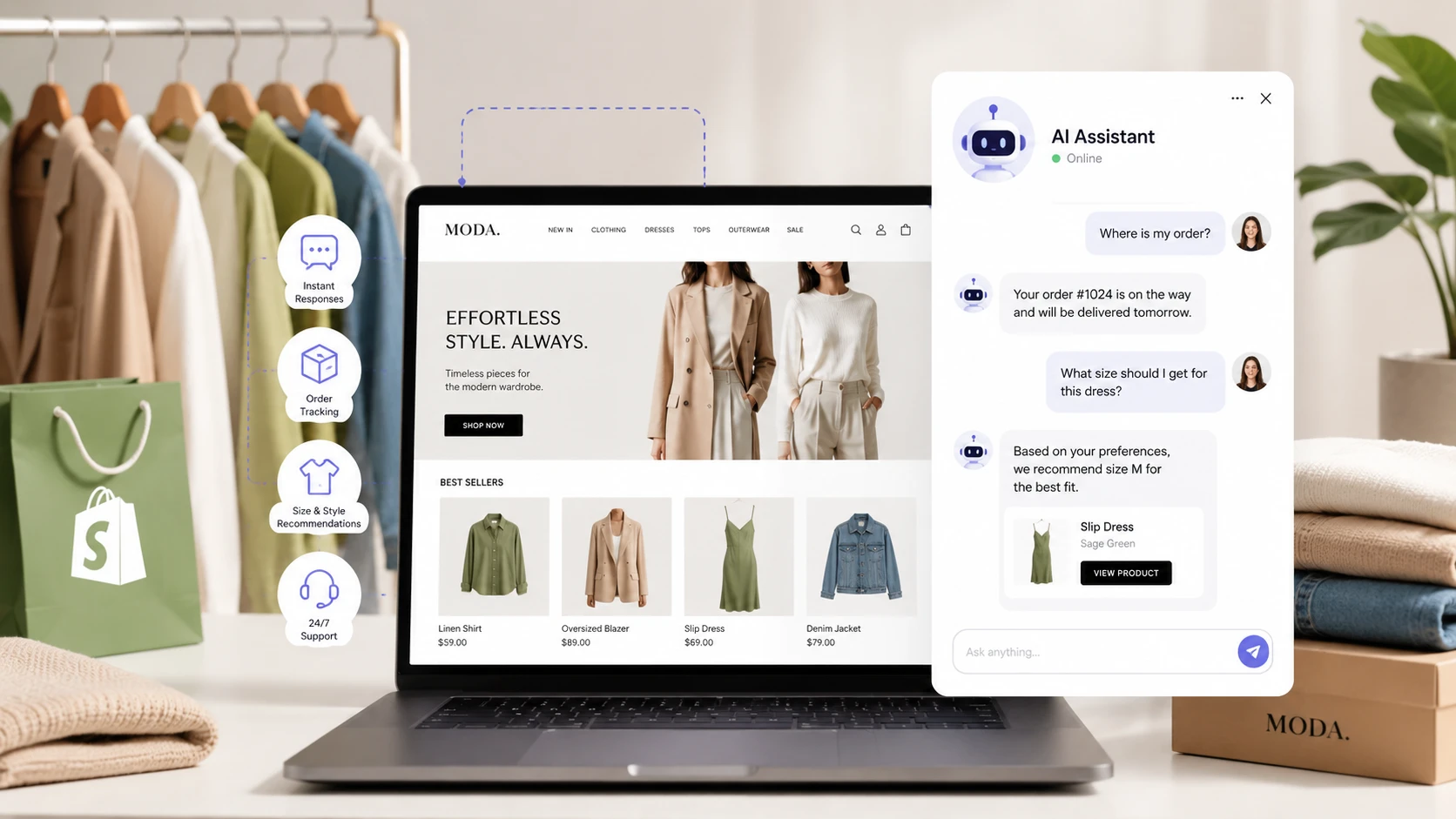
    For example, when someone asks, “Where is my order?” the agent should not simply send a generic tracking page. It should check the customer’s order, identify the shipping status, and provide a clear answer.

    When someone asks about returns, the agent should explain the policy, guide the customer through the process, and hand off to a human if the case is unusual.

    This layer can reduce pressure on support teams while improving response speed for customers.

    The Product Discovery and Sales Layer

    Support is only one part of the value.

    An ecommerce AI agent can also help shoppers discover the right products. This is especially useful in clothing, accessories, beauty, electronics, and any category where customers compare options before buying.

    Instead of showing generic recommendations, the agent can ask a few simple questions and narrow the options:

    • What occasion are you buying for?
    • Do you prefer a loose or fitted style?
    • What size do you usually wear?
    • Are you looking for something casual, formal, or seasonal?

    This feels closer to assisted shopping than standard ecommerce filtering.

    For stores that want to go further, AI can also connect with tools like virtual try-on, product matching, and personalized shopping flows. This is where AI virtual try-on software becomes relevant for clothing brands that want a more visual buying experience.

    The Retention and Post-Purchase Layer

    A strong AI agent does not stop after checkout.

    Post-purchase support is one of the biggest opportunities in ecommerce automation. The agent can help with tracking, delivery questions, return instructions, review requests, reorder reminders, and product care guidance.

    This is not always glamorous, but it has a direct impact on customer satisfaction.

    A shopper who gets quick help after buying is more likely to trust the store again.

    What AI Agents Can Automate in a Shopify Clothing Store

    For a Shopify clothing store, the most practical use cases are usually simple, repetitive, and high-volume.

    Here are the areas where an AI agent can make a visible difference.

    Product Questions

    Customers often ask about fabric, fit, measurements, colors, washing instructions, availability, or whether an item matches another product.

    If your product data is organized properly, the AI agent can answer these questions quickly without waiting for a human.

    This is one of the easiest areas to automate because the answers usually already exist somewhere in your product descriptions, size guides, policies, or internal notes.

    Size Guidance

    Sizing is one of the biggest friction points in fashion ecommerce.

    An AI agent can guide customers through size selection by asking structured questions and referencing your size chart. It can also explain whether an item runs small, large, fitted, oversized, or true to size if that information exists in your store data.

    This does not eliminate returns completely, but it can reduce avoidable mistakes.

    Order Tracking

    Customers asking “Where is my order?” are not trying to have a conversation. They want a fast answer.

    An AI agent connected to order and shipping data can provide that answer instantly. This saves time for both the customer and the support team.

    Returns and Exchanges

    Returns are repetitive, but they must be handled carefully.

    The agent can explain the return window, check eligibility, guide the customer through the steps, and collect the required information. For unusual cases, it can escalate to a human with the context already prepared.

    Abandoned Cart Recovery

    Sometimes a shopper abandons a cart because of a question that was never answered.

    An AI agent can help before that happens. If a customer is stuck on a product page or checkout step, the agent can offer specific help instead of generic discount pop-ups.

    For example:

    • “Need help choosing the right size?”
    • “Want to compare this with a similar item?”
    • “Looking for delivery information before checkout?”

    This is more useful than shouting “10% off” at every visitor.

    Common Myths About AI Agents for Ecommerce

    Let’s address a few myths that still create confusion.

    Myth 1: AI Agents Will Replace All Human Support Staff

    No. At least, not in a healthy setup.

    What usually happens is that the support team stops answering the same basic questions all day and starts handling the cases that actually need human judgment.

    The agent handles volume. Humans handle nuance.

    That means your best support people can focus on difficult customers, sensitive cases, high-value orders, and improving the customer experience instead of repeating “Here is our return policy” for the hundredth time.

    Myth 2: You Can Set It and Forget It

    Also no.

    An AI agent for ecommerce needs training, monitoring, and refinement. It is closer to having a smart assistant that learns quickly but still needs guidance on your policies, tone, product logic, and escalation rules.

    You will still need to review edge cases, improve product data, update policies, and adjust the agent’s behavior based on real conversations.

    It is less work than scaling a large support team, but it is not zero work.

    Myth 3: Only Big Brands Can Afford This

    This used to be more true than it is now.

    Small and mid-sized ecommerce stores are often strong candidates because they feel the pain of support volume earlier. They may not have the budget for a large customer service team, but they still need fast answers and consistent support.

    The key is choosing the right implementation level. Not every store needs a complex custom agent on day one.

    The Right Way to Implement an AI Agent

    The safest approach is not to automate everything at once.

    Smart stores start with one controlled use case, prove value, and then expand.

    Phase 1: After-Hours Support

    A simple first step is to deploy the AI agent outside business hours.

    Your human team continues handling normal daytime support, while the agent covers nights, weekends, and time zones your team cannot reach easily.

    This gives you a lower-risk way to test quality, train the system, and discover common gaps.

    Phase 2: Tier-1 Questions During Business Hours

    Once the agent performs well, it can start handling simple questions during normal hours too.

    These might include:

    • Order tracking.
    • Return policy questions.
    • Basic product information.
    • Size guide explanations.
    • Shipping time questions.

    Humans should remain available for escalations.

    Phase 3: Sales Assistance and Personalization

    After support automation is stable, the next step is sales assistance.

    This is where the agent starts helping shoppers choose products, compare options, and receive better recommendations.

    At this stage, the agent becomes part of the revenue system, not just the support system.

    Integration Requirements You Should Check First

    Before choosing any AI agent platform, check whether it can actually connect to the systems your store already uses.

    This is where many ecommerce AI projects succeed or fail.

    A nice demo is not enough. The agent needs reliable access to the right data, and it needs clear rules for what it can and cannot do.

    Essential Integrations

    At minimum, an AI agent for ecommerce usually needs access to:

    • Your ecommerce platform: Shopify, WooCommerce, or a custom store backend.
    • Product catalog: Product titles, descriptions, variants, images, stock status, and pricing.
    • Order data: Order status, customer details, payment status, and fulfillment updates.
    • Shipping tools: Tracking numbers, carrier updates, delivery estimates, and failed delivery notes.
    • Store policies: Returns, refunds, shipping rules, exchanges, warranty, and support terms.

    Without these connections, the agent becomes a smarter FAQ tool. With them, it becomes a real operational assistant.

    Advanced Integrations

    More advanced stores may also connect the agent to:

    • CRM systems.
    • Email marketing tools.
    • Loyalty programs.
    • Inventory management systems.
    • Analytics platforms.
    • ERP or custom internal systems.

    This is where custom software development may become necessary, especially if your store uses custom workflows that standard apps cannot handle cleanly.

    How to Choose the Right AI Agent for Ecommerce

    The market is full of tools calling themselves AI agents, AI chatbots, AI assistants, or customer support automation platforms. The names are less important than what the system can actually do.

    Here are the criteria that matter.

    1. Can It Take Real Actions?

    There is a big difference between a tool that says, “You can return your item from the returns page,” and a tool that can actually start the return process.

    The more actions the agent can safely perform, the more valuable it becomes.

    Useful actions might include:

    • Checking order status.
    • Starting a return request.
    • Recommending available products.
    • Collecting customer details before escalation.
    • Creating a support ticket.
    • Sending a product or policy link.

    Start with safe actions first, then expand gradually.

    2. How Does It Learn Your Store?

    Some AI tools require heavy manual setup. Others can learn from your product catalog, help center, policy pages, previous support conversations, and internal documents.

    Both approaches can work, but you need to know what is required before you start.

    For a clothing store, the agent should understand:

    • Product categories.
    • Size guides.
    • Fabric and material details.
    • Shipping rules.
    • Return policy details.
    • Brand tone and style.

    Poor training creates vague answers. Good training creates a useful assistant.

    3. Does It Escalate Properly?

    Escalation is one of the most important parts of ecommerce AI support.

    A bad AI agent keeps guessing when it should stop. A good AI agent knows when to bring in a human.

    Escalation should happen when:

    • The customer is angry or frustrated.
    • The case involves payment problems.
    • The agent is not confident.
    • The request is outside the store’s policy.
    • The customer asks for a human.
    • The order value or risk level is high.

    The handoff should include the conversation history so the human support agent does not need to ask the customer to repeat everything.

    4. Can You Control the Brand Voice?

    Your AI agent should not sound like a generic corporate robot.

    If your brand is playful, the agent should feel friendly and light. If your brand is premium, it should feel polished and calm. If your audience is technical, it can be more direct and detailed.

    Brand voice matters because the AI agent becomes part of the customer experience. Customers may not analyze the tone consciously, but they will feel when something is off.

    Risks and Limitations You Should Not Ignore

    AI agents can be powerful, but they are not magic. There are real risks, and pretending they do not exist is how bad implementations happen.

    Incorrect Answers

    AI systems can sometimes generate confident answers that are wrong. In ecommerce, that can mean incorrect product details, wrong delivery expectations, or policy confusion.

    The solution is to ground the agent in verified store data, restrict risky actions, and create clear escalation rules.

    Weak Product Data

    If your product data is messy, the AI agent will struggle.

    For example, if size charts are inconsistent, product descriptions are thin, and return rules are unclear, the agent has weak material to work with.

    Before blaming the AI, check the data.

    Over-Automation

    Not every customer interaction should be automated.

    Some situations need empathy, negotiation, or human judgment. If the agent blocks customers from reaching a human, it can damage trust quickly.

    The goal is not to hide your support team. The goal is to let the AI handle repetitive work while humans handle the cases that deserve human attention.

    Privacy and Compliance

    An ecommerce AI agent may process customer names, order information, messages, browsing behavior, and purchase history.

    That means privacy matters.

    You need to understand how the platform stores data, whether it uses customer conversations for training, what security controls exist, and whether it supports relevant privacy requirements in your market.

    For broader context on ecommerce AI use cases, Shopify’s guide to AI in ecommerce is a useful industry reference.

    How to Measure Success

    Do not judge an AI agent only by how many messages it sends. That number alone does not mean much.

    Measure whether it improves the business.

    Support Metrics

    Start with operational metrics:

    • Response time: How quickly customers get a useful answer.
    • Resolution rate: How many conversations are solved without human intervention.
    • Escalation rate: How often the agent needs a human.
    • Customer satisfaction: Whether customers are happy with the answer.
    • Support workload: Whether repetitive tickets decrease.

    These metrics tell you if the agent is actually helping your support process.

    Sales Metrics

    For ecommerce, support is only part of the picture.

    You should also look at:

    • Conversion rate.
    • Cart abandonment rate.
    • Average order value.
    • Repeat purchase rate.
    • Revenue from assisted sessions.

    A good AI agent can improve sales by answering objections at the right moment, helping customers choose, and making the buying process feel easier.

    When an AI Agent Is Worth It — and When It Is Not

    An AI agent for ecommerce is not necessary for every store.

    It is usually worth exploring if:

    • You receive repeated customer questions every week.
    • Your team spends too much time answering basic support tickets.
    • You sell products that require explanation or comparison.
    • Your store serves customers in different time zones.
    • You lose sales because shoppers do not get quick answers.
    • You are scaling and support costs are growing with revenue.

    You may want to wait if:

    • Your store has very little traffic.
    • Your product data is incomplete or messy.
    • Your policies change constantly.
    • You do not have anyone who can monitor and improve the system.

    The technology is no longer experimental, but it still needs a responsible setup.

    Final Thoughts

    An AI agent for ecommerce is not just a trend or a fancy chatbot. When implemented properly, it becomes a practical layer between your customers, products, policies, and support team.

    For Shopify clothing stores, the opportunity is clear. Customers need help with size, fit, availability, shipping, returns, and product choices. If those questions are answered quickly and naturally, the store has a better chance of converting visitors into buyers.

    The right approach is not to automate everything overnight. Start with the repetitive support questions. Connect the agent to reliable store data. Set clear escalation rules. Then expand into product recommendations, cart recovery, and post-purchase automation.

    Done well, an AI agent does not replace the human side of ecommerce. It protects it by removing repetitive work and giving people more time for the conversations that actually need them.

    If you want to build a more advanced customer support or ecommerce automation system, JustOnePrompt can help connect AI agents with Shopify workflows, store data, and custom automation logic through AI services and store automation.

    Frequently Asked Questions

    What is an AI agent for ecommerce?

    An AI agent for ecommerce is an autonomous system that helps customers across the buying journey. It can answer questions, recommend products, support returns, check order information, and escalate complex issues to humans when needed.

    How is an AI agent different from a normal ecommerce chatbot?

    A normal chatbot usually follows fixed scripts or simple keyword rules. An AI agent can understand context, use store data, make decisions within defined rules, and guide customers toward useful outcomes.

    Do Shopify clothing stores really need an AI agent?

    Not every store needs one immediately, but Shopify clothing stores with repeated questions about sizing, returns, shipping, product recommendations, or order tracking can benefit from an AI agent because it reduces response time and helps customers make buying decisions.

    Can an AI agent increase ecommerce sales?

    Yes, when implemented well. An AI agent can increase sales by answering product questions quickly, reducing abandoned carts, recommending relevant products, and helping customers feel more confident before checkout.

    Will an AI agent replace human support?

    Usually no. The best setup uses AI agents for repetitive questions and routine workflows, while human support handles complex, emotional, sensitive, or high-value cases.

    How long does it take to implement an AI agent in a Shopify store?

    A basic implementation can take a few days if the store uses standard Shopify apps and clear policies. A more advanced setup with custom workflows, integrations, and brand-specific training may take several weeks.

    What should I prepare before using an ecommerce AI agent?

    You should prepare clear product data, size guides, return policies, shipping rules, support FAQs, escalation rules, and examples of your brand voice. The better your data, the better the AI agent will perform.

  • How AI Agents Handle Shopify Customer Questions Automatically

    How AI Agents Handle Shopify Customer Questions Automatically

    AI agents for Shopify support are intelligent software systems that autonomously handle customer service inquiries, sales interactions, and operational tasks across your Shopify store—24/7, without needing constant human supervision.

    Last Tuesday, I watched my friend Sarah—who runs a small jewelry shop on Shopify—melt down over her laptop at 2 AM. She’d been trying to answer customer emails about shipping times, refund policies, and “does this necklace come in silver?” for the third night in a row. Her eyes were bloodshot, her coffee was cold, and she looked at me and said, “There has to be a better way.”

    Turns out, there is. AI agents for Shopify support have evolved way beyond those annoying chatbots that used to make us want to throw our phones across the room. These systems are becoming genuinely helpful members of your team—handling routine questions, guiding shoppers through checkout, and even making product recommendations that actually make sense.

    If you’re running a Shopify store and drowning in support tickets, or if you’re just curious about how AI can stop you from answering “where’s my order?” for the 47th time this week, stick around. We’re gonna break down exactly what these AI agents do, which ones are worth your time, and whether they’re actually as magical as everyone says they are.

    What Exactly Are AI Agents for Shopify Support?

    Think of an AI agent as a really smart assistant who never sleeps, never takes lunch breaks, and doesn’t get grumpy when the same person asks the same question three times in different ways. Unlike traditional chatbots that follow rigid scripts, these agents use machine learning and natural language processing to actually understand what customers are asking.

    They’re not just responding with canned phrases anymore. Modern Shopify AI support bots can pull information from your product catalog, check order statuses, process returns, and even make judgment calls about when to escalate something to a human. It’s kinda like having someone who’s read your entire FAQ section, memorized your return policy, and genuinely wants to help—except it’s software.

    The key difference between these agents and those frustrating bots from 2018? Autonomy. They can handle multi-step conversations, remember context from earlier in the chat, and take actions (like creating support tickets or updating order information) without someone clicking a button every time.

    Want to understand the foundational technology behind this? Check out What Is an AI Agent? for the deeper dive.

    Why Your Shopify Store Actually Needs This (And It’s Not Just Hype)

    Here’s the uncomfortable truth: your customers expect instant answers. Not “we’ll get back to you within 24 hours” answers. Instant. Like, right-now-while-I’m-deciding-whether-to-buy-or-bounce instant.

    The Real Business Impact

    When Sarah finally implemented an AI agent (spoiler: she did, and she’s sleeping better now), she noticed something fascinating. Her late-night email pile didn’t just shrink—it practically disappeared. The agent was catching about 70% of repetitive questions before they ever became tickets.

    But the benefits go deeper than just saving time:

    • Cost efficiency without sacrificing quality: Instead of hiring three more support reps, you’re investing in one system that scales infinitely
    • Consistency across every interaction: Your AI agent doesn’t have bad days or forget details about your return policy
    • Data goldmines: These systems track every question, revealing gaps in your product descriptions or confusing checkout flows
    • Global reach: Many AI agents handle multiple languages, turning your store into a true international operation
    • Cart abandonment rescue: Catching confused shoppers at the moment they’re about to leave and answering their “one quick question”

    The loyalty factor matters too. Customers who get immediate, helpful answers are way more likely to complete purchases and come back. It’s not rocket science—people remember when you make their life easier.

    How AI Agents for Shopify Support Actually Work Behind the Scenes

    Alright, let’s pull back the curtain without getting too technical. When a customer types “Can I return this if it doesn’t fit?” into your chat widget, here’s the magic happening in milliseconds:

    The Intelligence Pipeline

    Step 1: Understanding intent. The AI doesn’t just see keywords—it interprets what the customer actually wants. “Return policy,” “exchange,” and “I hate this product” might all trigger the same helpful response about your 30-day return window.

    Step 2: Context gathering. The system checks: Is this customer logged in? Do they have recent orders? Have they asked about this before? It’s building a complete picture before responding.

    Step 3: Action selection. Based on your configuration, the agent decides whether to answer directly, grab specific product info, check order status, or escalate to a human. This decision tree is way more sophisticated than old-school chatbots.

    Step 4: Learning and improving. Every interaction teaches the system something new. When customers rephrase questions or express frustration, the AI adjusts its approach.

    Integration With Your Shopify Ecosystem

    These agents don’t live in isolation. They plug directly into your Shopify store’s data—product catalogs, order histories, customer profiles, inventory levels. When someone asks “Is the blue sweater available in medium?” the agent checks your real-time inventory before responding.

    Most solutions also connect with your email platform, SMS systems, and social media channels. One unified brain handling conversations wherever your customers find you. No more fragmented experiences where the chat bot has no idea what you emailed about yesterday.

    Top AI Agent Solutions Worth Considering for Your Shopify Store

    Shopping for ai agents for shopify support can feel overwhelming. Everyone claims to be “powered by advanced AI” and “revolutionary.” Let’s cut through the marketing speak and look at what actually matters.

    The Heavyweight Contenders

    Gorgias has become something of a standard in the Shopify world. It’s built specifically for e-commerce, which means it understands things like “where’s my order” and “change my shipping address” without extensive training. The interface feels natural, and it plays nicely with apps you’re probably already using.

    Tidio attracts smaller stores with its approachable pricing and surprisingly capable free tier. You can start automating basic questions without spending a dime, then scale up as you grow. The visual bot builder makes customization less intimidating for non-technical folks.

    Richpanel earned its reputation as the “most loved” customer service app for Shopify merchants by focusing on the customer context. When someone contacts you, your team (or AI) sees their entire history, recommended actions, and can resolve issues in one screen. Less clicking, more solving.

    Specialized Players Doing Interesting Things

    Aidify leverages OpenAI technology (yes, the same company behind ChatGPT) to handle both chat and email management. If you want conversational abilities that feel genuinely human, this approach delivers more natural interactions.

    Debales AI Agent focuses specifically on the sales side—turning browsers into buyers through intelligent product recommendations and objection handling. If your primary pain point is conversion rather than support volume, this specialization might matter.

    Engaige positions itself as ready to deploy incredibly fast—some merchants report going live in under an hour. When speed matters more than extensive customization, that’s compelling.

    For a broader understanding of how these tools fit into the AI landscape, explore this analysis of AI trends in e-commerce for additional perspective.

    Common Myths That Need to Die Already

    Can we talk about the misconceptions floating around? Because some of them are stopping store owners from solutions that could legitimately change their business.

    Myth: “AI Will Make My Customer Service Feel Robotic”

    This was true in 2017. It’s not anymore. Well-implemented Shopify AI support bots can be configured with your brand voice, inject appropriate empathy, and know when they’re out of their depth and need to bring in a human. The goal isn’t to replace genuine human connection—it’s to handle the repetitive stuff so humans can focus on complex, emotionally nuanced situations.

    Sarah actually got a customer review that said “Your customer service is so responsive now!” after implementing her AI agent. The customer had no idea they’d been chatting with software for the first three exchanges.

    Myth: “It’s Too Complicated to Set Up”

    Some solutions require technical expertise, sure. But many modern platforms have basically become plug-and-play. You connect your Shopify store, answer some questions about your policies, and the system builds a knowledge base automatically by scanning your existing content.

    The learning curve is real, but it’s more like “an afternoon of focused setup” rather than “hire a developer for three weeks.”

    Myth: “Small Stores Don’t Need This”

    Actually, small stores might benefit most. When you’re wearing seventeen different hats and answering customer emails at 11 PM in your pajamas, automation isn’t luxury—it’s survival. You don’t need 10,000 monthly visitors to justify an AI agent. You just need enough repetitive questions that answering them is stealing time from product development, marketing, or (crazy thought) sleep.

    Myth: “AI Agents Will Lose Me Sales by Giving Wrong Information”

    This fear makes sense, but modern systems have guardrails. They’re trained on your specific information and can be configured to say “Let me connect you with someone who can help” when they encounter uncertainty. The risk of wrong information is actually higher with overworked human staff making tired mistakes.

    Real-World Implementation Examples (Without the Marketing Fluff)

    Let’s talk about what this actually looks like in practice, because theory is nice but examples are better.

    The Overwhelmed Solo Founder

    Remember Sarah? After setting up Tidio’s AI agent, she configured it to handle her top 15 most common questions—sizing info, shipping times, return policy basics, and “do you ship to [country]?” questions. Within two weeks, her support ticket volume dropped significantly. More importantly, her conversion rate improved because potential customers weren’t waiting hours for basic information.

    Her secret weapon? She spent an hour writing really thorough answers to those common questions in the AI’s knowledge base, using her actual brand voice. The AI essentially became a clone of her customer service personality for routine stuff.

    The Growing Brand Hitting Scale Problems

    A mid-sized apparel brand implemented Gorgias when they started getting hundreds of daily inquiries. Their AI agent now handles order tracking automatically—customers ask “where’s my order?” and get real-time updates without creating a ticket. It also manages simple exchanges and captures detailed information for issues that need human attention.

    Their support team went from constantly playing catch-up to actually having time for proactive customer outreach and handling genuinely complex situations. Employee satisfaction improved because nobody enjoys answering the same basic question 50 times a day.

    The International Expansion Challenge

    One merchant expanded from English-only to serving customers across Europe. Rather than hiring multilingual support staff immediately, they implemented an AI agent with translation capabilities. It handles German, French, Spanish, and Italian customer inquiries with the same policies and product knowledge, just translated appropriately.

    Is it perfect? No. Complex emotional situations still get escalated to humans who speak the language. But for “what materials is this made from?” and “how do I track my package?”—it works beautifully and made international expansion financially viable.

    The Strategy: Implementing AI Agents Without Breaking Everything

    You’re convinced this might help. Great! Now let’s talk about not screwing it up, because implementation strategy matters more than which specific tool you choose.

    Start With Your Pain Points, Not the Technology

    Before shopping for solutions, spend a week documenting your actual support volume. What questions come up repeatedly? What percentage of inquiries are basically looking up information versus solving complex problems? This data shapes your entire approach.

    If 60% of your tickets are “where’s my order?” you need aggressive order tracking automation. If your pain point is pre-purchase product questions, focus on AI that excels at product recommendations and specifications.

    The Hybrid Approach Works Best

    Don’t try to automate everything on day one. Start with ai agents for shopify support handling tier-one questions while humans manage everything else. As you build confidence in the system’s accuracy and customers respond positively, gradually expand its responsibilities.

    Smart escalation rules are your friend. “If customer uses words like ‘angry,’ ‘furious,’ or ‘lawyer,’ immediately route to human” is a simple rule that prevents PR disasters.

    Feed Your AI Agent Properly

    Your AI is only as good as the information you give it. Create a comprehensive knowledge base covering:

    • Detailed product specifications and common questions about each product category
    • Your complete shipping, return, and exchange policies with specific timeframes
    • Troubleshooting guides for common product issues
    • Brand voice guidelines so responses sound like you

    Then—and this matters—update this knowledge base whenever policies change or new product questions emerge. An AI agent working from outdated information creates more problems than it solves.

    Monitor and Iterate Like Your Business Depends On It

    The first month after implementation, review conversations weekly. Look for patterns where the AI misunderstood questions, gave unhelpful answers, or should have escalated but didn’t. Most platforms show you confidence scores—when the AI wasn’t sure about its response.

    This isn’t “set it and forget it” technology. It’s “set it and refine it continuously” technology. The good news? After the initial learning period, maintenance becomes way less intensive.

    What Could Possibly Go Wrong? (And How to Avoid It)

    Let’s get real about the potential pitfalls, because pretending AI agents are perfect is how you end up with angry customers and regrets.

    The Confidence Problem

    Sometimes AI agents are confidently wrong—they deliver incorrect information with zero hesitation. This is why human oversight and regular auditing matter so much, especially in the beginning. Set up alerts for negative sentiment in conversations and review those interactions quickly.

    The Uncanny Valley Effect

    When AI agents are almost human but not quite, they can feel creepy or frustrating to customers. Some stores solve this by being transparent: “Hi! I’m an AI assistant who can help with most questions immediately. For complex issues, I’ll connect you with the team.” Honesty builds trust.

    Over-Automation Backlash

    If customers can’t easily reach a human when they need one, frustration builds fast. Always provide a clear escape hatch: “Type HUMAN if you’d like to speak with our team” or a prominent “Chat with support team” button that bypasses the AI entirely.

    Data Privacy Concerns

    Your AI agent is processing customer data—names, order info, sometimes payment issues. Make sure whatever solution you choose is GDPR-compliant if you serve European customers, and that their data handling practices align with your privacy policy. This stuff matters more than features.

    Looking Ahead: Where This Technology Is Going

    AI agents for customer support are evolving faster than most technologies I’ve watched over the past decade. Current trends suggest some fascinating directions.

    Predictive support is emerging—systems that message customers before they even ask questions. “Hey, I noticed your order is arriving tomorrow. Here’s what to expect.” This flips the entire support model from reactive to proactive.

    Voice integration is becoming more sophisticated. Imagine customers calling your support line and having natural conversations with AI that sounds genuinely human, handles their request, and only escalates truly complex situations.

    Emotional intelligence is improving. Next-generation systems can detect frustration, confusion, or excitement in text and adjust their tone and approach accordingly. They’re learning empathy through pattern recognition.

    Cross-platform memory is getting better too. Soon, AI agents will remember that someone asked about sizing on Instagram, browsed your site, then messaged on your store chat—and have context for all of it in one continuous conversation.

    The trajectory is clear: these systems are becoming less like tools you use and more like team members who handle entire responsibilities with minimal supervision.

    So Should You Actually Do This?

    Here’s my honest take after watching merchants implement ai agents for shopify support with varying degrees of success.

    You’re probably ready if: you’re spending more than 10 hours weekly on repetitive customer questions, your response times are suffering because you can’t keep up, you’re considering hiring support staff but aren’t sure about the economics yet, or you’re losing sales because customers bounce before getting answers.

    You should probably wait if: you’re getting fewer than 20 customer inquiries weekly (the ROI math doesn’t work yet), your products are highly complex and require extensive expertise to discuss, you haven’t documented your basic policies and processes, or you’re not prepared to actively manage and refine the system for the first month.

    The technology has matured to the point where it genuinely works for most Shopify stores. But “works” means “improves your situation when implemented thoughtfully,” not “magically solves all problems instantly.”

    Start small, measure everything, and scale what works. The stores seeing the biggest wins aren’t necessarily using the fanciest AI—they’re the ones who matched the right tool to their specific needs and committed to making it work.

    What’s Next for Your Shopify Support Strategy?

    If you’re thinking about implementing AI agents, your next step is probably auditing your current support volume and common question patterns. Spend a week categorizing every inquiry that comes in. That data will tell you exactly where